
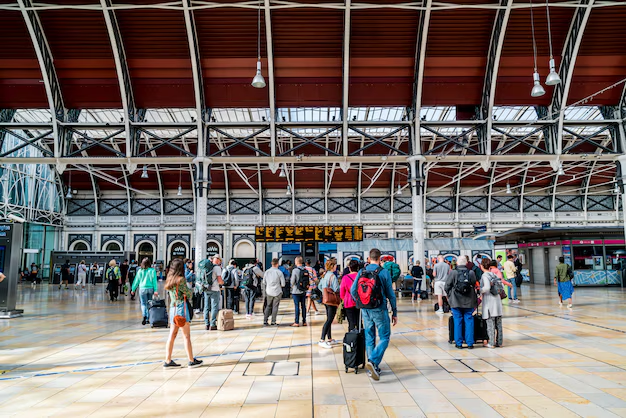
Hartsfield-Jackson Atlanta International Airport: The Complete Guide for Travelers
Hartsfield-Jackson Atlanta International Airport (airport code: ATL) is the primary commercial airport serving Atlanta, Georgia — and one of the busiest passenger airports in the world. Whether you're flying through for a connection or traveling to or from the city itself, understanding how ATL is organized, what to expect on the ground, and how to navigate it efficiently will save you real time and frustration.
Why ATL Is Unlike Most Other Airports
The sheer scale of Hartsfield-Jackson sets it apart immediately. The airport sits roughly ten miles south of downtown Atlanta and handles an enormous volume of both domestic and international traffic. Its position as a major Delta Air Lines hub means that a large share of all U.S. domestic connections pass through it — which is both a convenience and a source of significant congestion during peak travel periods.
What catches many first-time visitors off guard is the internal layout. ATL uses a underground automated people mover — the Plane Train — to connect its terminals and concourses. Missing this detail can lead to wandering above ground when the fastest route is below it.
Terminal and Concourse Layout
ATL has one main terminal building that splits into two sides: the Domestic Terminal (North and South) and the International Terminal (also called the Maynard H. Jackson Jr. International Terminal), which opened as a separate building in 2012 and is connected to the main complex.
From the main terminal, five concourses extend outward:
- Concourse T — the ticketing and check-in hub, directly connected to the main terminal
- Concourses A, B, C, D — domestic and some international gates
- Concourse F (International) — international departures and arrivals, located in the international terminal
The key thing to understand about navigation here is that Concourse F requires going through Customs and Border Protection, and the walk (or train ride) between Concourses A and F is longer than it looks on a map. If you're connecting between a domestic flight and an international departure, allow more time than you think you need.
The Plane Train: Your Primary Navigation Tool
The underground Plane Train runs continuously and connects the main terminal to Concourses T, A, B, C, D, and then to the International Terminal. It's free, runs frequently, and is almost always faster than walking the above-ground corridors. Trains loop in a fixed order, so if you miss your stop, you'll come back around — but that's a delay you don't want during a tight connection.
Walking the concourses above ground is an option some travelers prefer when they have time and want to access food or retail along the way. The above-ground Atrium connects the concourses on foot, and it's a more pleasant walk than most airports of this size — but it's significantly slower than the train.
Getting To and From the Airport
MARTA Rail: The Most Underused Option
Atlanta's MARTA Gold and Red rail lines stop directly inside the domestic terminal — in the basement level, adjacent to baggage claim. This is one of the cleaner and more straightforward airport rail connections in the United States. The ride to downtown Atlanta takes roughly 20 minutes under normal conditions, and the train deposits you at Five Points station, which serves as MARTA's central hub.
For travelers staying in Midtown, Buckhead, or downtown Atlanta, MARTA is often faster than driving, particularly during morning and evening rush hours when I-85 and I-285 can back up significantly in both directions.
The trade-off: MARTA doesn't reach every Atlanta neighborhood equally well, and it's a less practical option for travelers with large amounts of luggage or those heading to suburbs like Alpharetta, Marietta, or Decatur.
Rideshare and Taxis
Rideshare pickups (Uber, Lyft) operate from a designated ground transportation area on the domestic terminal's bottom level, separate from the taxi queue. This is a common source of confusion — many first-timers wait at the wrong curb. Follow the signage for "Ground Transportation" once you reach baggage claim level, not the arrivals curb directly outside baggage claim doors.
Drive time to downtown Atlanta varies widely — anywhere from 20 minutes late at night to well over an hour during rush hour or major events. Atlanta's traffic is genuinely unpredictable, and experienced travelers to ATL typically build in extra buffer time.
Rental Cars
Rental car facilities are not at the terminal itself. ATL uses the Consolidated Rental Car Center (CONRAC), which requires a shuttle ride from the terminal. Shuttles run continuously, but factor in the additional 10–15 minutes this adds to your total departure time when planning ahead.
Airlines and Destinations
Delta Air Lines dominates ATL, operating the majority of gates and offering the widest range of both domestic and international routes from this airport. That said, ATL is not exclusively Delta territory — travelers will find service from other major domestic carriers as well as a range of international airlines operating through the International Terminal.
International service from ATL covers destinations across Europe, Latin America, the Caribbean, Africa, and Asia. The airport's transatlantic and trans-African routes are particularly notable — Atlanta has historically been one of the primary U.S. gateways for flights to sub-Saharan Africa, a distinction that reflects the city's demographic and business connections to that region.
Connections at ATL: What You Should Know Before You Fly
ATL is one of the busiest connection hubs in the country, and connecting through it is a different experience than flying nonstop. A few things that experienced travelers know going in:
Concourse distance matters. A connection from a gate in Concourse B to a gate in Concourse F (international) involves a longer transit than almost any other concourse pairing. If your itinerary shows a tight connection and those are your concourses, treat it as a signal to be proactive.
The Plane Train can queue. During peak hours — typically mid-morning and late afternoon — the platform can be crowded, and you may need to wait for the next train. Not a crisis, but not something to ignore with 30 minutes to board.
Gate changes are common at large hubs. Check the ATL departure boards or your airline's app when you land, not just when you booked. Gates shift, especially for Delta's complex hub operations.
Airport Facilities Worth Knowing About
| Facility | Location | Notes |
|---|---|---|
| ATL SkyClub (Delta) | Multiple concourses | Requires Delta SkyClub membership or eligible card |
| TSA PreCheck lanes | All concourses | Standard availability; can vary by time of day |
| Global Entry kiosks | International Terminal | For eligible international arrivals |
| Nursing rooms | All concourses | Dedicated family-friendly spaces available |
| ATM and currency exchange | Main terminal + concourses | Currency exchange primarily near International Terminal |
| Cell phone lot | Off-site, South Terminal | Free waiting area for picking up passengers |
Food, Retail, and Wait Times
ATL has invested meaningfully in its concourse dining options, and the variety is genuinely better than many airports of comparable size. You'll find local Atlanta brands alongside national chains — the selection is strongest in Concourses A and B. International Terminal dining is more limited, though it has improved in recent years.
One practical note: food prices are airport-standard, meaning noticeably higher than street prices. If you're catching a long international flight and want to eat well beforehand, you're better served eating before you clear security, particularly if you're arriving at the airport from a hotel or downtown.
Security wait times at ATL can be substantial during morning departure banks. TSA PreCheck and CLEAR lanes move considerably faster, and many regular ATL travelers find that the investment pays for itself in stress reduction alone. Standard security on busy mornings at the domestic terminal can be a prolonged experience without expedited access.
Parking at Hartsfield-Jackson
ATL offers several parking tiers — domestic short-term, domestic long-term, economy parking, and the International Terminal's dedicated lot — with pricing that varies by proximity to the terminal and length of stay.
🅿️ Key distinctions:
- Domestic short-term is the most convenient but also the most expensive for multi-day trips
- Economy parking requires a shuttle, adding time to arrivals and departures
- Off-airport private lots exist in the surrounding area and can be more cost-effective for longer trips — though quality and shuttle frequency vary
For trips longer than two or three days, many experienced ATL travelers use off-airport parking or rideshare to avoid the cumulative cost of on-site parking, which adds up quickly.
Traveling Through Atlanta: City Context for Airport Users
ATL sits in an unusual position geographically: it serves a sprawling metro area, and the airport itself is to the south of the city, not the north or east where many major suburban corridors are located. This means travelers heading to Buckhead, Sandy Springs, or the northern suburbs face a longer ground transfer than travelers headed downtown or to the airport's immediate surroundings in Clayton County.
If your Atlanta trip is business-focused and centered in Midtown or downtown, MARTA is genuinely competitive with a car service. If your trip takes you to the suburbs, plan ground transportation carefully — Atlanta's surface road network is heavily dependent on a few major arteries that congest predictably.
Quick-Reference: ATL at a Glance
| Detail | Information |
|---|---|
| Official name | Hartsfield-Jackson Atlanta International Airport |
| IATA Code | ATL |
| Location | Approximately 10 miles south of downtown Atlanta |
| Terminals | Domestic Terminal (N/S) + International Terminal |
| Concourses | T, A, B, C, D (domestic); F (international) |
| Primary hub carrier | Delta Air Lines |
| Rail access | MARTA Gold and Red Lines |
| Rental cars | Off-site CONRAC (requires shuttle) |
ATL rewards preparation more than most airports. Its scale, the volume of connections it handles daily, and the complexity of its layout mean that travelers who understand the system — which train to take, where rideshare actually picks up, how much time a cross-concourse connection really requires — move through it smoothly. Those who don't often find themselves frustrated by delays that were entirely avoidable. Come in knowing the layout, and Atlanta's airport becomes what it was designed to be: one of the most connected hubs on the continent.