
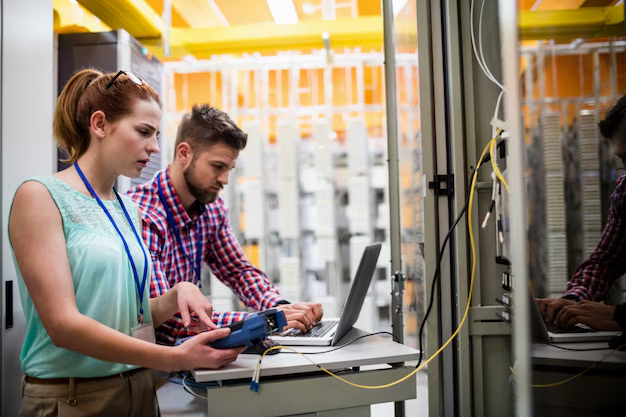
Atlanta Data Centers: How They Work, Where They Are, and What Locals Should Know
Atlanta has quietly become one of the Southeast’s major data center hubs. If you live or do business in the city, there’s a good chance your apps, websites, and cloud services are being powered by servers sitting in or around metro Atlanta.
Whether you’re a business owner comparing Atlanta data center options, an IT professional planning a move, or just curious how this industry fits into the city, this guide walks through the essentials with a local lens.
Why Atlanta Is a Major Data Center Market
Several factors make Atlanta, Georgia attractive for data centers:
- Strategic location in the Southeast, with strong connectivity to other major cities.
- Power infrastructure supported by large regional utilities.
- Transportation access via Hartsfield-Jackson Atlanta International Airport and major interstates (I‑75, I‑85, I‑20, I‑285).
- Growing tech and business ecosystem, including Fortune 500 headquarters and startups.
- Moderate disaster risk compared with coastal cities that face hurricanes or areas with frequent earthquakes.
For companies based in Atlanta—or serving customers in the Southeast—hosting in a local data center can help reduce latency, improve reliability, and support compliance needs that favor in-region data storage.
Types of Data Centers You’ll Find in Atlanta
Data centers in the Atlanta metro area come in several forms. Understanding the differences will help you decide what fits your needs.
1. Colocation (Carrier-Neutral) Data Centers
These are facilities where businesses rent space, power, and cooling for their own servers. You supply the hardware; the facility provides the environment and connectivity.
Typical features:
- Shared building with server cabinets, cages, or full suites
- Multiple network carriers for redundancy
- Strict security controls (badges, biometrics, 24/7 guards)
- On-site remote hands support for basic physical tasks
This model is common for Atlanta-based companies that want control over hardware but don’t want to operate their own facility.
2. Cloud and Hyperscale-Oriented Sites
Large cloud providers and major tech companies operate or lease space in bigger, often more hidden facilities around the metro area. These are designed for:
- Massive compute and storage needs
- Very high power capacity
- Advanced cooling and redundancy
Local businesses may not lease directly from these hyperscale sites, but their cloud services often run through them, especially in and around Atlanta.
3. Enterprise and On-Premises Data Centers
Some Atlanta-based organizations, especially in sectors like finance, higher education, and healthcare, maintain their own:
- On-campus data centers
- Private server rooms in office buildings
- Disaster recovery sites in nearby suburbs
These are often used when data control, security policies, or legacy systems make third-party hosting less practical.
Key Atlanta Neighborhoods and Corridors for Data Centers
You’ll find data centers sprinkled throughout Downtown, Midtown, and the wider metro area, often near strong fiber routes and power infrastructure.
A few commonly recognized corridors and areas include:
- Downtown / Five Points / Peachtree corridor – Older and newer telecom and carrier facilities, strong network density.
- Midtown – Close to technology companies, universities, and research institutions, often favored for connectivity and proximity to corporate offices.
- Perimeter / Sandy Springs / Dunwoody – Popular for office parks and enterprise data center space, with easy access to I‑285 and GA‑400.
- Norcross / Duluth / Peachtree Corners – Known for industrial and tech-focused parks with room for larger data center campuses.
- Douglasville / Lithia Springs / East Point / College Park – Home to industrial-zoned land with access to power and highways, sometimes used for larger, more power-hungry sites.
Data centers are usually non-descript buildings with strong security and limited signage, so you may drive past several without realizing what they are.
What Atlanta Businesses Typically Use Data Centers For
Organizations in Atlanta use data centers for a wide range of needs:
- Running business-critical applications (ERP, CRM, financial systems)
- Hosting websites and e‑commerce platforms serving customers across the Southeast
- Storing and backing up data with redundancy and disaster recovery
- Supporting hybrid cloud setups: some workloads in the cloud, some in local colocation
- Providing low-latency services for local users—important in sectors like fintech, logistics, and media
If your company’s users or customers are concentrated in or near Atlanta, placing servers in a local data center can improve responsiveness and user experience.
Key Factors to Consider When Choosing an Atlanta Data Center
When comparing Atlanta data centers, most businesses focus on a few core areas.
1. Location and Access
Things to consider locally:
- Proximity to your office: Can your IT team reach the facility quickly via I‑75, I‑85, I‑20, or MARTA if needed?
- Traffic and travel time: Rush-hour patterns around Downtown, Midtown, and the Perimeter can be significant.
- Risk profile: Avoid locations with frequent localized flooding or chronic power delivery issues.
For example, companies headquartered in Midtown may look at data centers along Peachtree Street, near Georgia Tech, or in nearby Buckhead or the Perimeter for convenient access.
2. Power and Cooling Capacity
In Atlanta’s hot, humid summers, reliable cooling is essential:
- Ask about redundant power feeds, backup generators, and battery systems.
- Understand maximum power per rack if you run high-density equipment.
- Clarify how the facility handles heat waves and grid strain.
3. Network Connectivity
Atlanta is a major network crossroads in the Southeast. When evaluating providers:
- Check how many carriers and ISPs are available in the building.
- Ask about direct connections to cloud providers or regional network exchanges.
- Consider latency needs if you serve users in Atlanta, Charlotte, Nashville, Birmingham, or Jacksonville.
4. Security and Compliance
Physical and logical security are critical:
- Multi-factor access controls (badge + PIN + biometrics)
- 24/7 on-site security staff and camera coverage
- Strong visitor policies and audit logs
Depending on your industry, you may also need a facility that supports:
- HIPAA-related safeguards for healthcare data
- Financial or payment industry controls
- Local, state, or contractual data-handling requirements
5. Scalability and Growth
Atlanta is a growing tech hub, so planning ahead helps:
- Confirm you can add racks, cages, or suites as your business grows.
- Ask about future expansion plans within the same building or campus.
- Check whether the facility can handle higher density if you adopt newer server hardware.
Typical Services Offered by Atlanta Data Centers
Most Atlanta data centers offer a similar base set of services, with variations in depth and specialization.
Core Services
- Colocation space (rack units, locked cabinets, cages, or private suites)
- Power and cooling, designed for continuous operation
- Network connectivity with carrier options and cross-connects
- 24/7 access for authorized personnel
Common Add-On or Managed Services
- Remote hands: Staff who can reboot servers, swap drives, check cabling, and perform basic tasks without your team driving in.
- Backup and storage solutions
- Disaster recovery support, including secondary sites in or outside metro Atlanta
- Security services, such as managed firewalls or monitoring (varies by provider)
When speaking with a provider, ask which services are included in the base price and which come with additional fees.
Atlanta Data Center Checklist: What to Ask on a Tour
If you’re planning an in-person visit, here’s a quick checklist of questions tailored to Atlanta conditions:
| Area | Key Questions to Ask in Atlanta |
|---|---|
| Power | How did the facility perform during past summer heat waves or regional storms? |
| Cooling | What cooling systems are in place for peak August temperatures and humidity? |
| Network | Which carriers are on-site, and what are typical latencies to major Southeast cities? |
| Security | How is access controlled, and how are visitors escorted and logged? |
| Support | Is on-site staff available 24/7 including weekends and holidays? |
| Growth | How much additional space and power can you reserve for future expansion? |
| Resilience | What is the redundancy level (for example, N+1 or higher) for power and cooling? |
Bringing this list to a tour can help you compare options consistently.
Power, Utilities, and Local Considerations
Power and Utility Providers
Most large data centers in and around Atlanta rely on major regional utilities such as Georgia Power and local municipal or EMC providers in surrounding counties. When evaluating facilities, it’s reasonable to ask:
- Who provides primary power to the building?
- What is the history of outages at that site?
- How long can generators operate during an extended event?
Weather and Natural Events
Atlanta doesn’t face the same hurricane risks as coastal cities, but there are still considerations:
- Severe thunderstorms and occasional tornado activity
- Ice storms or snow events that can disrupt transportation and local infrastructure
- Summer lightning and high heat that can stress power systems
Well-designed Atlanta data centers plan for these scenarios with multiple layers of backup and response procedures.
Latency and Serving the Southeast from Atlanta
Many companies select an Atlanta data center specifically to serve users across the Southeast:
- Businesses in Georgia, Alabama, Tennessee, and the Carolinas often see strong performance when hosting in Atlanta.
- Local peering and carrier options help keep latency low for regional customers.
- If you operate a multi-region setup, Atlanta can act as a Southeast hub alongside locations in other U.S. regions.
When talking with a potential facility, ask for sample latency numbers to your key customer cities.
Practical Steps for Atlanta Businesses Considering Colocation
If your organization is based in or near Atlanta and thinking about moving into a data center, a simple process might look like this:
Define your requirements
- How many racks or how much space you need
- Power requirements per rack
- Uptime, security, and compliance expectations
Narrow your preferred area
- For example: Downtown/Midtown for fast access, or Norcross/Perimeter for more space and potentially lower costs.
Shortlist facilities
- Select a few that match your location and basic technical needs.
Schedule site visits
- Tour each data center, using the checklist above.
- Pay attention to physical condition, cleanliness, and staff professionalism.
Review contracts and SLAs
- Focus on uptime guarantees, response times for support, and escalation procedures.
Plan the migration
- Coordinate shipping, installation, and testing to minimize downtime.
- Consider timing around Atlanta traffic and peak business hours.
Using Atlanta as Part of a Redundancy Strategy
Some organizations pair an Atlanta data center with a second site elsewhere to increase resilience. Common patterns include:
- Primary in Atlanta, backup in another Southeast city
- Primary cloud-based with Atlanta colocation as a local cache or failover site
- Split workloads, with critical systems in a hardened Atlanta facility and less critical systems in the cloud
For local companies, this can balance performance for Atlanta-area users with broader disaster recovery strategies.
When a Full Data Center Isn’t Necessary
Not every Atlanta business needs dedicated colocation. You may not need a data center if:
- Most of your operations are already in public cloud services.
- Your applications aren’t latency-sensitive, and you can operate fully from remote regions.
- Your IT footprint is small enough to run reliably in a secure, well-managed server room on-site.
However, as your needs grow—or if compliance, performance, or control become more important—exploring Atlanta data center options often becomes a practical next step.
Understanding how data centers operate in Atlanta helps you make better decisions about where your data lives, how your services perform, and how your business can scale in the Southeast. Whether you’re colocating a single rack or building a multi-site strategy, Atlanta offers a mature, well-connected environment to support your plans.