
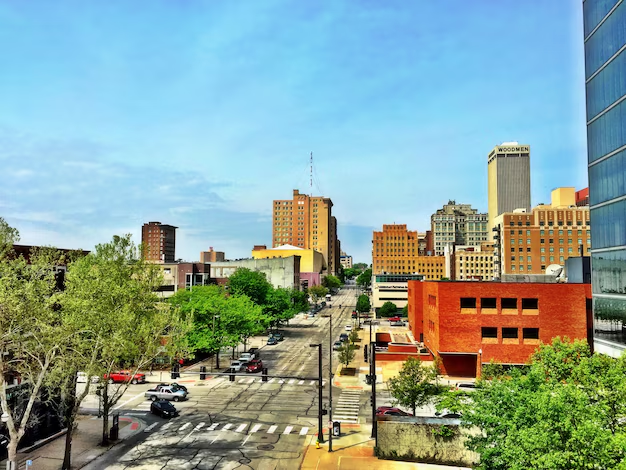
Atlanta City History: How a Railroad Crossroads Became the Capital of the New South
Atlanta’s history is unusually fast-paced for an American city. In less than 200 years, a railroad junction in the woods turned into the capital of Georgia, a hub of the Civil Rights Movement, and today’s sprawling metro center of the Southeast.
If you live in Atlanta, visit often, or are simply trying to understand how Atlanta became Atlanta, knowing its history makes the city’s neighborhoods, streets, and landmarks feel very different. That odd street grid downtown, the name “Five Points,” the gold dome at the Capitol, the Martin Luther King Jr. sites on Auburn Avenue, even Hartsfield-Jackson airport—all of it fits into a story.
Below is a clear, Atlanta-focused guide to the city’s history, organized so you can connect what you read to places you can actually see today.
From Railroad Terminus to “Atlanta” (1830s–1850s)
A city built for tracks, not for horses and carriages
Atlanta did not start as a port, a colonial capital, or an old river town. It began as Terminus, a planned endpoint for railroads that would connect the interior of Georgia to the rest of the South and beyond.
- In the 1830s, Georgia leaders chose a spot in north Georgia for the end of the Western & Atlantic Railroad.
- This point was originally called Terminus, then Marthasville, and later renamed Atlanta in 1845.
- The name “Atlanta” is widely understood to be linked to the Western & Atlantic Railroad—essentially a railroad-inspired name.
If you stand today at Five Points in downtown Atlanta (where Peachtree St., Decatur St., Edgewood Ave., Marietta St. and others meet), you’re near the historic heart of that original rail junction. The diagonal streets and rail-adjacent layout come straight out of the railroad-first design of the 1840s.
Early growth and a city of newcomers
By the 1850s, Atlanta had:
- A growing cluster of rail yards, depots, warehouses, and hotels
- A reputation as a transportation and commercial center, rather than a plantation center
- A population made up largely of newcomers, including many people who arrived by train from elsewhere in the South
This pattern—people arriving from somewhere else—is part of Atlanta’s story from the very beginning and still shapes the city’s culture today.
Civil War Atlanta: Fire, Ruin, and a Famous March (1860s)
Strategic target and Confederate hub
When the Civil War broke out, Atlanta quickly became one of the most important Confederate logistics hubs because of its railroads and factories. It produced and moved:
- Weapons and munitions
- Food and supplies
- Troops moving from one front to another
Because of this, it became a prime target for Union General William T. Sherman.
The Siege of Atlanta and Sherman’s “March to the Sea”
In 1864, the Union Army advanced into north Georgia and eventually besieged Atlanta. After months of fighting:
- Confederate forces evacuated.
- Union forces occupied the city.
- Much of Atlanta’s rail infrastructure, industrial facilities, and many buildings were destroyed by fires set as troops prepared to leave.
The idea of Atlanta being “burned” is central to its identity. It appears in the city’s modern use of the phoenix—a mythical bird rising from the ashes—which you can see on:
- The City of Atlanta seal
- Public art and murals around the city
- Branding and naming of local businesses and organizations
Reconstruction and the “Phoenix City” (1870s–1890s)
From ashes to capital of Georgia
After the Civil War, Atlanta rebuilt quickly. Within a few years:
- Rail service was restored.
- Businesses reopened and expanded.
- In 1868, Atlanta replaced Milledgeville as the capital of Georgia.
If you visit the Georgia State Capitol at 206 Washington St. SW, the gold dome you see symbolizes that “New South” optimism. The Capitol stands roughly where the city’s postwar government asserted Atlanta’s new role as the political center of the state.
The “New South” vision
In the late 1800s, business leaders in Atlanta promoted the idea of a “New South”:
- More industrial and commercial
- Closely linked to Northern capital and trade
- Emphasizing railroads, cotton commerce, and later manufacturing
At the same time, racial segregation, the disenfranchisement of Black voters, and a system of unequal laws and customs shaped people’s daily lives, housing patterns, and access to economic opportunity. These realities set the stage for the conflicts and activism that would emerge in the 20th century.
Early 20th Century Atlanta: Growth, Tension, and Culture
Segregated city and the 1906 Atlanta Race Riot
By the early 1900s, Atlanta was:
- A clearly segregated city with separate Black and white neighborhoods
- Growing through streetcar suburbs, including many intown neighborhoods that remain today (such as parts of Inman Park, Grant Park, and West End)
- Increasingly tense over issues of race, jobs, and political power
In 1906, Atlanta was the site of a deadly race riot. White mobs attacked Black residents and businesses, particularly in downtown areas. This event:
- Deepened racial divisions
- Strengthened Black community institutions, including churches and fraternal organizations
- Contributed to the concentration of Black business and professional life along Auburn Avenue
Today, when you walk Auburn Ave. NE—especially the stretch known historically as “Sweet Auburn”—you’re in what was once called one of the most prosperous Black business districts in the United States.
Business boom and city services
In the first decades of the 1900s, Atlanta expanded:
- Streetcar lines spurred the development of neighborhoods like Virginia-Highland and Druid Hills.
- Downtown became a center for retail, banking, and hospitality.
- The city invested in water systems, schools, and parks, including the expansion of Grant Park (home to Zoo Atlanta today).
“Sweet Auburn” and Black Atlanta Leadership
Auburn Avenue as a powerhouse
By the 1920s–1940s, Sweet Auburn was a thriving center of Black life:
- Home to the Atlanta Life Insurance Company, Black-owned banks, and professional offices
- Anchored by major churches such as Ebenezer Baptist Church (407 Auburn Ave. NE)
- A neighborhood where Black business owners, doctors, lawyers, and civic leaders lived or worked
This concentration of economic and spiritual life gave Black Atlanta a strong institutional backbone, which later supported the Civil Rights Movement.
Atlanta and the Civil Rights Movement (1950s–1960s)
Birthplace and base for key leaders
Atlanta played a major national role in the Civil Rights era. Many of the leaders who shaped that movement lived, worked, and organized in the city:
- Dr. Martin Luther King Jr., born and raised in Atlanta
- Ralph David Abernathy and other leaders associated with the Southern Christian Leadership Conference (SCLC), which was headquartered in the city
- Activists and students from Morehouse College, Spelman College, Clark College (now Clark Atlanta University), and other schools in the Atlanta University Center
You can see this legacy today in the Martin Luther King Jr. National Historical Park, which includes:
- King’s childhood home on Auburn Ave. NE
- Ebenezer Baptist Church
- The King Center and his tomb
These sites, located just east of downtown, are a direct link between Atlanta’s neighborhoods and national history.
“The city too busy to hate”
During the 1950s and 1960s:
- Atlanta marketed itself as “the city too busy to hate”.
- Some business and civic leaders sought gradual desegregation to protect the city’s economic growth and image.
- At the same time, Black leaders and students organized sit-ins, boycotts, and legal challenges to end segregation in public spaces and schools.
These efforts led to changes in:
- Public accommodations (restaurants, hotels, and theaters)
- Public transportation
- Voting access and political representation
The slogan did not match everyone’s experience—many Atlanta residents still faced discrimination and violence—but it captured the city’s push to link progress on civil rights with economic development.
Modern Government and Political Change
City leadership and representation
From the late 1960s onward, Atlanta experienced major political shifts:
- Growing Black political power and representation
- Election of Maynard Jackson in 1973 as Atlanta’s first Black mayor, a major milestone nationally
- Expansion of city programs focused on inclusion in city contracts, housing, and public hiring
City Hall, at 55 Trinity Ave. SW, is the operational center of this modern government. If you’re an Atlanta resident, many of the services you access—permits, zoning, public records—flow through this building and the agencies it houses.
The Rise of the Atlanta Airport and Transportation Hub
From local airfield to global gateway
Atlanta’s transportation focus shifted over time from railroads to aviation:
- In the 1920s, the city established a municipal airport on what was then Candler Field.
- Over decades, that airfield evolved into Hartsfield-Jackson Atlanta International Airport, located just south of the city.
The airport’s growth:
- Reinforced Atlanta’s position as a regional and international hub
- Attracted corporate headquarters, conventions, and tourism
- Influenced where people live and work, especially in south metro communities
Today, if you commute along I-75, I-85, or the MARTA Airport Station, you’re part of this long history of Atlanta as a transportation city.
Suburban Expansion, Highways, and Sprawl (1950s–1990s)
Interstates and changing neighborhoods
The construction of major interstate highways profoundly changed Atlanta:
- I-75, I-85, and I-20 were built through and around the city.
- Highway routes cut through established neighborhoods, including African American communities, displacing residents and businesses.
- Suburban development expanded into Cobb, DeKalb, Fulton, Clayton, and Gwinnett counties and beyond.
These projects helped create the car-dependent metro region many Atlantans know today, with:
- Long commutes
- A strong culture of driving
- Ongoing debates about transit, density, and housing affordability
MARTA and public transit
To balance car dependency, the region built MARTA (Metropolitan Atlanta Rapid Transit Authority), which:
- Operates rail lines (Red, Gold, Blue, and Green) connecting parts of Fulton and DeKalb counties
- Runs bus routes throughout the city and into some neighboring areas
MARTA rail and bus lines follow patterns shaped by earlier rail corridors and streetcar routes, making transit today part of a longer history of transportation in the city.
The Olympic Era and Global Spotlight (1990s)
Atlanta wins the 1996 Summer Games
In the early 1990s, Atlanta successfully bid to host the 1996 Summer Olympic Games, a moment that:
- Put the city on a global stage
- Led to major investments in downtown and surrounding areas
- Accelerated construction of new venues, housing, and transportation improvements
Key places associated with the Olympic era include:
- Centennial Olympic Park (265 Park Ave. W NW) – a central green space built as a gathering point for the Games
- The former Olympic Stadium, later converted into Turner Field, and now repurposed as Center Parc Stadium for Georgia State University
The Olympics also drew attention to issues such as:
- Homelessness and displacement
- The impact of rapid development on existing neighborhoods
Many of the buildings, hotels, and attractions tourists see downtown grew out of this period.
21st Century Atlanta: Growth, Diversity, and Ongoing Change
Population growth and neighborhood change
In the 2000s and 2010s, Atlanta experienced:
- A resurgence of intown living, as people moved back into neighborhoods closer to downtown and Midtown
- Significant redevelopment in areas like Old Fourth Ward, West Midtown, Atlantic Station, and around the BeltLine
- Ongoing gentrification, particularly in historically Black neighborhoods, raising concerns about displacement and affordability
When you walk or bike along the Atlanta BeltLine—especially the Eastside Trail—you’re using a trail built on former railroad corridors that once served the city’s industrial backbone. This project physically “recycles” Atlanta’s railroad origins into a new kind of public space.
Cultural hub and media center
Atlanta has grown into a major cultural and entertainment center, known for:
- Hip-hop and music scenes, centered around local studios and venues
- A thriving film and television industry, with many productions shot in and around the city
- Institutions like the High Museum of Art, the Fox Theatre, and a wide range of festivals and events
These modern industries fit neatly into Atlanta’s long history as a place where people come together to trade, create, and move ideas and goods.
Key Eras of Atlanta History at a Glance
| Era | Rough Dates | What Defined Atlanta Then | Places to See It Today |
|---|---|---|---|
| Railroad Founding | 1830s–1850s | Rail junction, “Terminus,” then “Atlanta” | Five Points, downtown rail corridors |
| Civil War & Destruction | 1860s | Confederate supply hub, siege, burning of the city | Historical markers near downtown and the Capitol |
| Reconstruction & New South | 1870s–1890s | Rapid rebuilding, state capital, industrial growth | Georgia State Capitol, older commercial downtown blocks |
| Segregation & Sweet Auburn | 1900s–1940s | Racial segregation, Black business district on Auburn Avenue | Sweet Auburn Historic District |
| Civil Rights Movement | 1950s–1960s | MLK Jr., SCLC, sit-ins, gradual desegregation | MLK Jr. National Historical Park, AUC campuses |
| Highways & Suburban Era | 1950s–1990s | Interstates, suburban expansion, MARTA, corporate growth | I-75/85 “Downtown Connector,” MARTA rail system |
| Olympic & Global City | 1990s–2000s | 1996 Olympics, downtown redevelopment, international branding | Centennial Olympic Park, Georgia World Congress Center |
| BeltLine & Intown Revival | 2000s–Present | Intown growth, redevelopment, creative industries, ongoing inequality | BeltLine trails, Old Fourth Ward, West Midtown |
How Atlanta’s History Shapes Daily Life Today
If you live in or visit Atlanta, you are constantly moving through layers of history:
- Street patterns downtown follow the original rail lines and early roads.
- Neighborhood identities—from Buckhead to West End to East Atlanta—reflect past waves of annexation, segregation, and redevelopment.
- Transit debates can’t be separated from the city’s long reliance on transportation corridors, from rails to interstates.
- Civic institutions, such as the Atlanta City Hall, Fulton County Government Center, and Georgia State Capitol, are placed where political power gravitated over time.
- Cultural pride and tension around race, class, and growth stem from the same forces that shaped Sweet Auburn, the Civil Rights Movement, and modern redevelopment.
Understanding Atlanta city history doesn’t just explain the past; it helps make sense of why the city looks, feels, and functions the way it does today—how a rail junction became a major Southern metropolis, and why Atlanta continues to reinvent itself while carrying the imprint of everything that came before.