
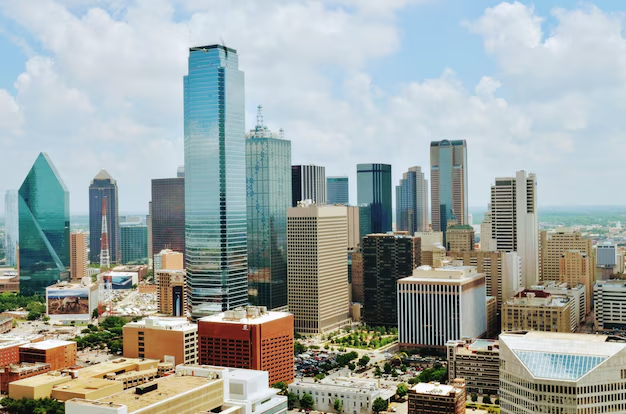
Atlanta, Georgia: A Local’s Guide to the City
Atlanta is more than just Georgia’s capital. It’s a fast-growing, diverse city with strong neighborhoods, a major airport, world-class entertainment, deeply rooted history, and a booming economy. Whether you live in Atlanta, are visiting, or are considering a move, understanding how the city works day-to-day helps you get much more out of it.
Below is a practical, Atlanta-focused guide to the city’s layout, services, transportation, neighborhoods, and everyday life.
Atlanta at a Glance
Atlanta sits in north-central Georgia and anchors the Atlanta metropolitan area, often called “Metro Atlanta” or “the ATL.” The City of Atlanta itself covers parts of Fulton County and a portion of DeKalb County.
Key things Atlanta is known for:
- Transportation hub – Home to Hartsfield-Jackson Atlanta International Airport.
- Business & jobs – Headquarters for many major companies and a strong film, tech, and logistics scene.
- Civil Rights history – Birthplace of Dr. Martin Luther King Jr. and a central city in the Civil Rights Movement.
- Universities – Georgia Tech, Georgia State University, Atlanta University Center schools (Clark Atlanta, Spelman, Morehouse), and more.
- Culture & food – Southern cuisine, diverse international food, hip-hop, sports, and festivals year-round.
How the City of Atlanta Is Organized
City Government and Services
Atlanta is governed by a strong mayor–council system.
Mayor’s Office
City Hall
55 Trinity Ave SW
Atlanta, GA 30303
Main line: (404) 330-6000Atlanta City Council – Sets local laws, approves budgets, and represents city districts.
City departments – Handle public works, water, planning, zoning, parks, and public safety.
If you live in the city, you’ll typically deal with the City of Atlanta for:
- Water and sewer service
- Trash and recycling (within city limits)
- Building permits and zoning questions
- Business licenses
- Property taxes if you’re within the city and Fulton or DeKalb County portions of Atlanta
For county-level services such as courts and some property issues, you’ll interact with:
Fulton County Government
Government Center
141 Pryor St SW
Atlanta, GA 30303
Main line: (404) 612-4000DeKalb County Government (for eastern sections of the city)
1300 Commerce Dr
Decatur, GA 30030
Main line: (404) 371-2000
Neighborhoods and Districts
Atlanta is often described as a “city of neighborhoods.” Some of the most recognized in-city areas include:
- Downtown – Government buildings, major attractions, stadiums, and hotels.
- Midtown – High-rises, arts institutions, Piedmont Park, walkable blocks.
- Buckhead – Upscale shopping, business offices, and dense residential towers.
- Old Fourth Ward (O4W) – Historic Civil Rights sites and BeltLine access.
- West Midtown / Westside – Converted warehouses, food halls, arts spaces.
- Virginia-Highland, Inman Park, Grant Park – Tree-lined streets, historic homes, local restaurants.
- East Atlanta, Edgewood, Kirkwood – More eclectic, with nightlife and community events.
- Southwest & Southeast Atlanta – Large residential areas with long-established communities and new development.
Many Atlantans also identify strongly with Intown (inside the Perimeter) vs. OTP (outside I-285, in surrounding suburbs).
Getting Around Atlanta
Atlanta’s transportation can feel very different depending on whether you stick to central neighborhoods or travel across the metro area.
Highways and Major Roads
Most locals organize their mental map around:
- Interstate 285 (“the Perimeter”) – Loops around the city; inside is “ITP,” outside is “OTP.”
- I-75 / I-85 (“the Connector”) – Merge downtown; heavily traveled north–south corridor.
- I-20 – East–west interstate cutting across central Atlanta.
Rush-hour traffic is common, so plan extra travel time if you’re crossing town between 7–9 a.m. or 4–7 p.m.
Public Transit: MARTA
MARTA (Metropolitan Atlanta Rapid Transit Authority) runs heavy rail and bus services.
- Rail lines: Red, Gold, Blue, and Green lines connecting North Springs–Airport, Doraville–Airport, and East–West corridors through Downtown and Midtown.
- Buses: Serve city neighborhoods and some nearby suburbs.
Common MARTA uses:
- Getting to Hartsfield-Jackson Atlanta International Airport
- Attending events at Mercedes-Benz Stadium, State Farm Arena, Georgia World Congress Center
- Commuting to Downtown, Midtown, Buckhead, and some job centers
MARTA Headquarters:
2424 Piedmont Rd NE
Atlanta, GA 30324
Customer service (general info): (404) 848-5000
Airport: Hartsfield-Jackson
Hartsfield-Jackson Atlanta International Airport (ATL) is a major reason Atlanta is considered a transportation hub.
- Located about 7–10 miles south of Downtown
- Directly connected to MARTA’s Red and Gold rail lines at the Airport Station
- Many residents use ATL for both domestic and international travel
Airport main information line: (800) 897-1910
Walking, Biking, and the BeltLine
In many in-town neighborhoods, walking and biking are realistic options for daily errands and recreation.
Key corridors:
- Atlanta BeltLine – A growing network of trails circling the core of the city. Popular segments include:
- Eastside Trail (Old Fourth Ward, Inman Park, Ponce City Market)
- Westside Trail (Adair Park, West End, Westview)
- Piedmont Park – Central park with walking/running paths and bike access.
For biking, Atlanta has a mix of:
- Dedicated bike lanes (more common in Midtown and nearby neighborhoods)
- Multi-use paths (like the BeltLine and PATH trails)
- Neighborhood streets where cyclists share the road
Living in Atlanta: Everyday Essentials
Utilities and City Services
If you live inside the City of Atlanta, you’ll typically work with:
Atlanta Department of Watershed Management – Water, sewer, and stormwater services.
72 Marietta St NW
Atlanta, GA 30303
Customer service: (404) 546-0311Department of Public Works – Trash, recycling, and some street maintenance within city limits.
55 Trinity Ave SW
Atlanta, GA 30303
Main line: (404) 330-6240
Electricity is commonly provided by Georgia Power in the Atlanta area, though some surrounding communities use local utilities.
Natural gas service is often from natural gas marketers operating on a deregulated network, so residents choose from available providers.
Housing and Neighborhood Choice
When choosing where to live in Atlanta, locals often weigh:
- Commute time to work or school
- Transit access (especially MARTA rail proximity if you don’t want to drive daily)
- Walkability and access to grocery stores, parks, and restaurants
- School districts if you have children
- Type of housing – historic homes, newer townhomes, high-rise apartments, or single-family houses
Intown neighborhoods (like Midtown, Old Fourth Ward, Inman Park, and Grant Park) tend to offer:
- Shorter drives or transit to central job centers
- Higher walkability and more mixed-use development
- Higher average housing costs compared with some suburbs
Suburban areas outside the city limits (OTP) commonly offer:
- More single-family homes and larger lots
- Different school district options
- Increased driving dependence, but sometimes easier highway access
Working and Doing Business in Atlanta
Major Employment Areas
While jobs are scattered throughout the metro, large clusters exist in:
- Downtown Atlanta – Government, hospitality, tourism, and some corporate offices
- Midtown – Technology, engineering, education, healthcare, and arts organizations
- Buckhead – Finance, consulting, and professional services
- Perimeter Center (Sandy Springs/Dunwoody area) – Large office complexes and corporate HQs (OTP but heavily used by city residents)
- Film and TV production hubs – Throughout the metro area, with offices and stages inside and outside the city
Starting or Running a Business in Atlanta
If you are opening a business within city limits, you typically need:
- A City of Atlanta business license
- Zoning approval for your business location
- Possible additional permits (signage, building modifications, food service, etc.)
You can usually handle business licensing and permitting through:
City of Atlanta – Office of Revenue / Business Licensing
55 Trinity Ave SW
Atlanta, GA 30303
Main line: (404) 330-6270
Businesses must also follow state-level registration and licensing rules through Georgia’s state agencies.
Education in Atlanta
K–12 Public Schools
Atlanta’s central city school system is Atlanta Public Schools (APS).
APS main office:
130 Trinity Ave SW
Atlanta, GA 30303
Phone: (404) 802-3500
Key points:
- School attendance zones vary by address; residents often verify which school they are zoned for using APS tools or by contacting the district.
- The Atlanta metro also includes multiple other county school systems (Fulton, DeKalb, Cobb, Gwinnett, etc.), but those typically serve areas outside the City of Atlanta’s core.
- Families sometimes consider charter schools, magnet programs, and private schools depending on location and preferences.
Colleges and Universities
The city hosts several major institutions:
- Georgia Institute of Technology (Georgia Tech) – Engineering, tech, and research; located in Midtown.
- Georgia State University (GSU) – Large urban campus in Downtown, strong in business, law, public policy, and the arts.
- Atlanta University Center (AUC) – Includes Clark Atlanta University, Morehouse College, and Spelman College in the West End area.
- Additional campuses: Emory University (near, but technically outside, City of Atlanta limits), Oglethorpe University, and others nearby.
These schools shape Atlanta’s student population, research activity, and job market, especially in Midtown and Downtown.
Culture, Attractions, and Things to Do
Major Attractions in the City
Some of the most visited and recognizable places in Atlanta include:
- Georgia Aquarium – One of the largest aquariums in the world, located in Downtown.
- World of Coca-Cola – Museum dedicated to the history and brand, also Downtown.
- National Center for Civil and Human Rights – Near Centennial Olympic Park, highlighting global and local civil rights stories.
- Martin Luther King Jr. National Historical Park – In the Old Fourth Ward area; includes Dr. King’s birth home and Ebenezer Baptist Church.
- Atlanta BeltLine – Popular for walking, biking, and connecting neighborhoods.
- Piedmont Park – The city’s “central park,” hosting festivals and offering skyline views.
Sports and Entertainment
Atlanta has teams and venues right in the city:
- Atlanta Falcons (NFL) and Atlanta United FC (MLS) – Play at Mercedes-Benz Stadium in Downtown.
- Atlanta Hawks (NBA) – Play at State Farm Arena, also Downtown.
- College sports – Georgia Tech and other universities host regular games close to the city core.
The city also has a strong music and nightlife scene, particularly:
- Midtown and Downtown clubs and venues
- Edgewood Avenue and East Atlanta Village for local bars and live music
- Large concert venues and theaters throughout the city
Parks, Outdoors, and Green Spaces
While Atlanta is known for its skyline, it’s also heavily wooded and full of parks.
Notable public spaces:
- Piedmont Park – Central hub for walking, festivals, and recreation.
- Grant Park – Historic park featuring Zoo Atlanta.
- Chastain Park – On the north side, with an amphitheater and extensive recreation.
- Westside Park – A large newer park with views of the city, built around a former quarry.
- Atlanta BeltLine Trails – Connects multiple parks and neighborhoods.
Parks and recreation are managed primarily by:
City of Atlanta Department of Parks and Recreation
233 Peachtree St NE, Suite 1700
Atlanta, GA 30303
Main line: (404) 546-6813
Public Safety and Emergency Services
For emergencies in Atlanta, residents and visitors rely on:
Atlanta Police Department (APD) – City police services
226 Peachtree St SW
Atlanta, GA 30303
Non-emergency line: (404) 614-6544Atlanta Fire Rescue Department (AFRD) – Fire and emergency response
226 Peachtree St SW
Atlanta, GA 30303
Main line (non-emergency): (404) 546-7000
For immediate emergencies, call 911.
Neighborhoods may also have community watch programs, neighborhood planning units (NPUs), and local associations that coordinate with police and city officials.
Key Atlanta Basics: Quick Reference
| Topic | Who/What You’ll Use in Atlanta | Typical Next Step |
|---|---|---|
| City services (water, trash) | City of Atlanta departments | Contact City Hall / Watershed / Public Works |
| Public transit | MARTA rail and bus | Check rail/bus routes and schedule |
| Air travel | Hartsfield-Jackson Atlanta International Airport (ATL) | Use MARTA Airport Station or parking/shuttles |
| Schools (in-city) | Atlanta Public Schools (APS) | Confirm your address’s school zone |
| Business licensing | City of Atlanta Office of Revenue | Apply for city business license and verify zoning |
| Parks and recreation | City of Atlanta Parks and Recreation | Find nearest park, rec center, or program |
| Safety / emergencies | APD, AFRD, and 911 | Use 911 for emergencies; non-emergency lines for other issues |
Visiting Atlanta vs. Living in Atlanta
If you’re visiting Atlanta:
- Focus on Downtown/Midtown/Buckhead for hotels and easy MARTA access.
- Use MARTA or rideshare to get between the airport, central attractions, and major event venues.
- Plan extra time around major events (football games, conventions, concerts), as traffic and crowds increase near stadiums and arenas.
If you’re living in Atlanta or moving here:
- Decide whether you prefer intown living (shorter commutes, higher density) or suburban areas (more space, more driving).
- Get familiar with your NPU (Neighborhood Planning Unit) and local neighborhood association; they influence zoning, development, and community events.
- Learn your MARTA access points, typical traffic patterns, and closest major roads quickly—it will make daily life smoother.
Atlanta is a city of constant change—new developments, transit projects, and neighborhood transformations are typical. Understanding the city’s layout, services, transportation options, and local institutions gives you a strong foundation to navigate life here, whether you’re here for a weekend or planning to stay long-term.