
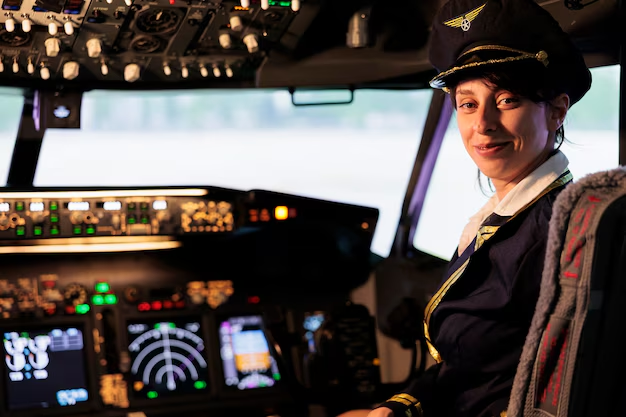
Atlanta Flight Schools: How to Start Flying in the ATL
Learning to fly in Atlanta, Georgia gives you access to busy airspace, major airports, and year-round flying weather. Whether you want a Private Pilot License (PPL) for fun, a commercial pilot career, or just a discovery flight over the city, Atlanta’s flight schools offer nearly every option.
This guide walks you through how flight training works in Atlanta, what to look for in a school, major airports and training locations in the metro area, typical costs and timelines, and practical next steps if you’re ready to get started.
How Flight Training Works in Atlanta
Most Atlanta flight schools follow the same basic structure set by the Federal Aviation Administration (FAA), but the local airspace, weather, and airport choices shape your experience.
Common types of pilot training available
In the Atlanta area, you’ll typically find:
Discovery or Intro Flights
A 30–60 minute flight with an instructor where you can take the controls and see if you enjoy flying.Private Pilot License (PPL)
The foundation for most pilots. Lets you fly small aircraft for non-commercial purposes.Instrument Rating (IR)
Trains you to fly in clouds and low visibility using instruments. Very relevant in Atlanta’s variable weather.Commercial Pilot License (CPL)
Required to get paid to fly. Often paired with multi-engine training.Certified Flight Instructor (CFI / CFII / MEI)
Allows you to teach other pilots and is a common first job for aspiring airline pilots.Multi-Engine Rating
Training to fly airplanes with more than one engine (often needed for career paths).
Some Atlanta schools also offer:
- Airline career programs or “zero-to-hero” tracks
- Airline transport pilot (ATP) prep
- Tailwheel, aerobatic, or advanced training (less common, but available within driving distance)
Where People Train in and Around Atlanta
The Atlanta metro area has multiple general aviation airports that host flight schools. Training at a busy airport can give you strong communication and traffic-management skills; training at a quieter field may mean shorter taxi times and faster flight scheduling.
Key training airports in the Atlanta area
Here’s a simplified overview of commonly used airports for flight training in and around Atlanta:
| Area / Direction | Airport Name | FAA ID | Typical Use for Students |
|---|---|---|---|
| West of downtown | Fulton County Airport – Brown Field | KFTY | Busy GA airport; mix of training and biz jets |
| Northwest / Marietta | Cobb County Int’l – McCollum Field | KRYY | Popular training hub; multiple schools |
| Northeast / Gwinnett | Gwinnett County Airport – Briscoe Fld | KLZU | High training activity; good access from suburbs |
| East / Dekalb | DeKalb–Peachtree Airport (PDK) | KPDK | Major GA airport; towered, busy, very active GA |
| South / Peachtree City | Atlanta Regional – Falcon Field | KFFC | Training, GA traffic; near pilot community |
| South of ATL | Henry County, Cherokee Co., others | Varies | Some schools, typically less congested |
Flight schools are usually based at one of these airports, so where you live or work in Atlanta will strongly influence the most convenient choice.
FAA Basics: Who Regulates Flight Schools in Atlanta?
All pilot training in Atlanta falls under FAA regulations, mainly:
- Part 61: More flexible, instructor-based training.
- Part 141: FAA-approved school programs with structured syllabi.
You can train under either system in the Atlanta area. Some schools even operate both.
Part 61 vs. Part 141 (in plain language)
Part 61 (Flexible Route):
- You train directly with a certified instructor.
- Often easier to fit around work and family schedules.
- Minimum hours for a Private Pilot License: 40 hours (many students take more).
Part 141 (Structured Route):
- Training through an FAA-approved school with a set curriculum.
- Sometimes shorter minimum hour requirements (for PPL, often 35 hours minimum).
- Often helpful if you’re pursuing college programs or some financial aid or visas.
In the Atlanta area, you’ll find both types. Recreational students often choose Part 61 for flexibility, while career-focused students sometimes prefer Part 141 programs or accelerated “academy” style schools.
What To Look for in an Atlanta Flight School
With multiple flight schools spread across metro Atlanta, choosing one comes down to more than just location.
1. Airport environment and airspace
Atlanta sits under or near multiple layers of controlled airspace, including:
- Hartsfield–Jackson Atlanta International Airport (KATL) Class B airspace
- Class D and C airspace at nearby towered airports
Training in or near busy airspace can actually be a strength:
- You’ll gain confidence talking to air traffic control (ATC).
- You’ll get used to traffic management and sequencing, useful if you plan to fly cross-country or pursue airline work.
However, this can mean:
- More delays for takeoff or landing at peak times.
- Potentially more time on the ground waiting for clearances.
If you want less congestion, consider schools based at slightly less busy airports (often on the edges of the metro area).
2. Fleet and maintenance
Ask Atlanta flight schools about:
- Number and type of training aircraft (Cessna 172, Piper Warrior/Archer, Diamond, etc.)
- Availability of glass cockpit aircraft (e.g., Garmin G1000) vs. traditional analog (“steam”) gauges.
- On-site maintenance vs. off-site mechanics.
In a busy metro like Atlanta, aircraft availability matters. A school with a small fleet and many students may be harder to schedule, especially on weekends or evenings.
3. Instructor availability and experience
Key questions to ask when you tour:
- How many full-time and part-time instructors are on staff?
- What’s the average instructor experience level?
- Can I stay with one primary instructor for consistency?
Atlanta is a popular place for time-building instructors aiming for airline jobs, so there can be turnover. That’s normal, but a school with good scheduling and communication can make transitions smoother.
4. Ground school options
You’ll need ground school (theory) in addition to flight time:
Common formats in Atlanta:
- In-person classes at the flight school or a local campus
- One-on-one ground with your instructor
- Self-paced online ground school, then sign-offs through local instructors
If you prefer classroom learning, look for schools that offer regularly scheduled ground courses.
Typical Costs of Flight Training in Atlanta
Costs vary by:
- Aircraft type and hourly rate
- Instructor fees
- Fuel prices (which can shift)
- How frequently you fly and how quickly you learn
But for ballpark expectations in the Atlanta area:
Private Pilot License (PPL) – Local ballpark
Many Atlanta students budgeting for a PPL plan for something like:
- Aircraft rental (wet): Typically charged per hour (Hobbs time), often in the 3-figure range per hour for a four-seat trainer.
- Instructor time: Charged per hour for both flight and ground.
- Supplies: Headset, charts, books, kneeboard, EFB subscription (optional but common).
- Written exam and checkride fees: Paid to testing center and examiner.
By the time you include flight hours, instruction, and required tests, local pilots often find their total out-of-pocket cost ends up in the low- to mid-five-figure range for a Private Pilot License in the Atlanta area.
Training for an Instrument Rating or Commercial License adds more time and cost on top of that.
💡 Tip: In Atlanta’s busy weather and airspace, flying at least 2–3 times per week often helps you finish faster and avoid re-learning skills, which can reduce total cost.
How Long Does It Take to Learn to Fly in Atlanta?
Timelines depend heavily on your schedule and consistency.
Approximate timelines (for local students)
Very frequent training (4–5 days/week):
Some Atlanta students complete a PPL in 3–4 months.Moderate pace (2–3 days/week):
Many finish in 6–9 months.Part-time or irregular schedule (less than 1–2 days/week):
It might take 9–18 months or more.
Atlanta’s weather includes:
- Hot, humid summers with afternoon thunderstorms
- Occasional IMC (low visibility) that can cancel VFR training flights
Schools typically help you plan around seasonal patterns, and these weather delays are factored into realistic training timelines.
Medical Certificates and Local FAA Resources
Before you solo, you’ll usually need an FAA Medical Certificate (for most training paths). This is separate from the flight school.
In Atlanta, you’ll typically:
- Use the FAA MedXPress system (online) to start the application.
- See an Aviation Medical Examiner (AME) in the Atlanta area for an exam.
- Receive a First, Second, or Third Class Medical, depending on your goals.
The Atlanta metro has multiple AMEs; many are located in or near major medical office clusters in Buckhead, Midtown, Decatur, and northern suburbs. Flight schools often maintain an up-to-date list of local AMEs they work with regularly.
For regulatory questions, the FAA Atlanta Flight Standards District Office (FSDO) is a key regional resource:
- FAA Atlanta FSDO
1701 Columbia Ave
College Park, GA 30337
Phone: (404) 305-7150
The FSDO handles matters like certifications, safety programs, and some enforcement or regulatory questions.
What It’s Like to Train in Atlanta’s Airspace
Atlanta’s skies are relatively busy compared to many smaller cities, which can be an advantage for your training if managed well.
Benefits of training in metro Atlanta
Strong ATC communication skills
You’ll get used to talking to tower, approach, and departure control, which many pilots find invaluable later on.Real-world traffic scenarios
Pattern work alongside business jets, training aircraft, and transient traffic teaches situational awareness.Diverse nearby destinations
From Atlanta-area airports, you can easily plan cross-country flights to:- Smaller Georgia towns
- The mountains of North Georgia
- Coastal destinations (planned over longer legs)
Challenges to plan around
Busy periods
Morning and late afternoon can be congested. Some schools suggest off-peak times for early solo students.Weather
Thunderstorms in warm months can pop up quickly. Good Atlanta schools heavily emphasize weather decision-making and go/no-go judgment.Airspace complexity
You’ll spend time early in training learning airspace charts, especially around Hartsfield–Jackson’s Class B.
Questions to Ask When Visiting an Atlanta Flight School
When you tour a flight school at PDK, RYY, LZU, FTY, or other Atlanta-area airports, bring a short checklist:
Training structure
- Are you operating under Part 61, Part 141, or both?
- Can you walk me through a typical Private Pilot training syllabus here?
Costs, billing, and scheduling
- What are your hourly rates for aircraft and instructors?
- Do you offer any block time discounts or payment plans?
- How far in advance do I typically need to book lessons?
Instructors and fleet
- How many instructors are currently active?
- How many primary training aircraft are available?
- What type of avionics do your trainers use (traditional vs. glass cockpit)?
Student progress and support
- How do you track my progress?
- Do you offer ground school classes or one-on-one ground instruction?
- How do you handle instructor turnover?
Career pathways (if applicable)
- Do you have any airline partnerships or hiring pathways?
- Can you help with time-building after my initial ratings?
Getting Started: Step-by-Step for Aspiring Atlanta Pilots
If you live in or near Atlanta and want to start flying, here’s a practical approach:
Clarify your goal
- Just want to fly for fun? Focus on PPL.
- Want a career? Plan your path through PPL, Instrument, Commercial, and CFI, potentially via a structured program.
Pick a convenient airport
- Northwest suburbs? Look at schools at McCollum (KRYY).
- Buckhead / Brookhaven / Chamblee? DeKalb–Peachtree (KPDK).
- Northeast suburbs? Gwinnett (KLZU).
- Westside or downtown? Fulton County (KFTY).
- South side or Peachtree City area? Falcon Field (KFFC).
Schedule a discovery flight
- Most Atlanta flight schools offer a trial lesson where you fly with an instructor.
- Use this to see if you enjoy the feel of flying and the school’s atmosphere.
Meet staff and ask detailed questions
- Talk to instructors, schedulers, and current students if possible.
- Compare at least two schools around Atlanta for fit.
Plan timing and budget
- Look at your schedule and aim for 2–3 flights per week if possible.
- Build a realistic budget including aircraft, instructor, supplies, and exam fees.
Handle medical and student pilot certificate
- Schedule an appointment with a local AME for your medical.
- Work with your instructor to obtain your student pilot certificate through the FAA’s system.
Commit to consistency
- In Atlanta’s fast-paced environment, consistency is key. Treat your training as a standing appointment to make steady progress.
Helpful Local Contacts and References
While each flight school will have its own contact info, these official and regional points often come up during training in Atlanta:
Hartsfield–Jackson Atlanta International Airport (KATL)
Major commercial hub; important to understand its surrounding Class B airspace when training nearby.FAA Atlanta FSDO
1701 Columbia Ave
College Park, GA 30337
Phone: (404) 305-7150Local GA Airports Commonly Used for Training
You’ll find flight schools based at:- DeKalb–Peachtree (KPDK) in Chamblee
- Cobb County – McCollum (KRYY) in Kennesaw
- Gwinnett County – Briscoe Field (KLZU) in Lawrenceville
- Fulton County – Brown Field (KFTY) near I-20 west of downtown
- Atlanta Regional – Falcon Field (KFFC) near Peachtree City
If you’re in the Atlanta area and curious about flying, visiting one of these airports on a clear day, watching pattern traffic, and talking to a local flight school is usually the most eye-opening first step.