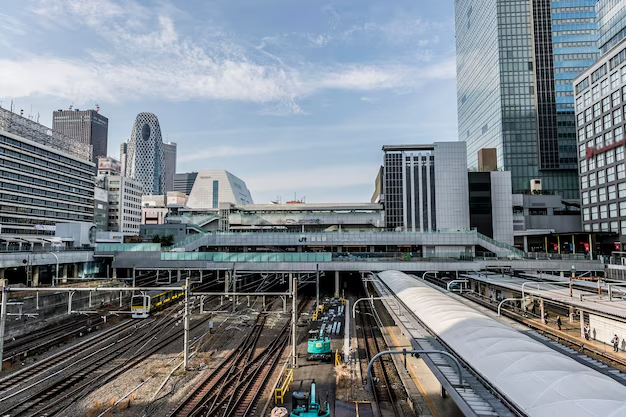
When people say “Atlanta Terminus,” they’re usually talking about two related things:
If you live in Atlanta, are visiting, or are just trying to understand the city, knowing what “Terminus” means helps make sense of how Atlanta developed—and why certain parts of the city look and feel the way they do today.
Before Atlanta was Atlanta, it was literally called Terminus.
In the 1830s and 1840s, Georgia planned railroad lines to connect the interior of the state with the rest of the South and beyond. The planned end point—the “terminus” of the Western & Atlantic Railroad—was placed in what is now downtown Atlanta.
You can still feel this history:
If you’re curious about this era, the Atlanta History Center (130 W Paces Ferry Rd NW, Atlanta, GA 30305) has exhibits that explain how Terminus evolved into Atlanta.
Today, most locals who say “Terminus” are talking about the Terminus office and mixed‑use complex in Buckhead.
The Terminus development anchors the intersection of Peachtree Road NE and Piedmont Road NE in Buckhead. It typically includes:
Approximate central address often associated with the complex:
This area is easily recognizable by its modern glass towers and its location just north of Buckhead Village and south of the Lenox/PHIPPS shopping area.
While specific tenants change over time, you’ll typically find:
For Buckhead workers, Terminus is a daytime hub. For visitors, it’s a convenient landmark for:
If you’re planning to visit or commute to the Terminus area, you have a few realistic options.
There is no dedicated “Terminus” station, but you’re close to two key stops:
Buckhead Station (Red Line)
Lenox Station (Gold Line)
From either station, you can:
Tip: If you’re unfamiliar with Buckhead’s hilly, busy streets, a rideshare from the station can be simpler, especially in summer heat.
The Terminus complex is located near the GA‑400 and I‑85 / I‑75 connectors:
Parking options typically include:
Traffic in Buckhead is notably heavy during:
If you have flexibility, plan meetings or visits slightly off‑peak for smoother access.
Understanding “Atlanta Terminus” helps you see how the city’s fabric fits together.
This explains:
So when you hear “Terminus” today, context matters:
If you’re exploring Atlanta and want to understand “Terminus,” you can experience both the historic concept and the modern complex in a day.
Consider:
You won’t see a sign that says “Terminus” downtown, but you’ll be standing where that early rail town grew up.
Head to:
Nearby, you’ll also find:
This gives you a good feel for how Atlanta’s old “rail terminus” city evolved into a modern, multi‑center metro with several business hubs.
| Aspect | What “Terminus” Means in Atlanta Today |
|---|---|
| Historical meaning | Original name for the railroad endpoint that grew into Atlanta |
| Historic location area | Near present‑day Downtown (Five Points / Underground Atlanta / the Gulch) |
| Modern common meaning | Buckhead’s Terminus office and mixed‑use complex |
| Modern area address | Around 3280 Peachtree Rd NE, Atlanta, GA 30305 (Peachtree & Piedmont) |
| Main uses now | Corporate offices, dining, nearby residential, Buckhead business hub |
| How locals use the term | Usually referring to the Buckhead complex, not the historic name |
If you’re in conversation and someone mentions “Terminus”:
In a business or networking context, especially in Buckhead:
They almost certainly mean the Terminus towers (Terminus 100/200 area).
In a history, architecture, or city‑planning conversation:
They may be referring to Atlanta’s origins as a railroad terminus and the city’s early name.
If you’re unsure, a simple clarification like, “Do you mean the office towers in Buckhead, or the historic name?” usually clears it up.
Understanding Atlanta Terminus is really about understanding how the city began at the end of a rail line—and how that legacy shows up today in a sleek glass complex in Buckhead that borrowed the old name for a new era.