
Are Atlanta’s Roads Safe To Drive On? What New (and Future) Residents Should Know
If you’re thinking about moving to metro Atlanta, you’ve probably heard two things about driving here: traffic is intense and drivers are aggressive. Both can be true. But that still leaves the core question: are the roads safe to drive on in Atlanta?
The honest answer: Atlanta is drivable and survivable if you’re prepared, but it’s not a “set it on cruise control and relax” kind of city. Road safety here depends a lot on:
- Where you’re driving (Downtown vs. Johns Creek vs. South DeKalb)
- When you’re on the road
- How familiar you are with local driving culture and infrastructure
This guide walks through the realities of driving in Atlanta, the biggest risks, and what you can do to stay safe — whether you’re commuting from Buckhead, cutting across I-20 from Douglasville, or navigating neighborhood streets in East Atlanta.
Atlanta Driving Safety At A Glance
Quick reality check for new and relocating drivers:
| Topic | What to Expect in Atlanta | Safety Takeaway |
|---|---|---|
| Highways (I-75/85, I-285, GA-400, I-20) | Fast, congested, heavy lane changing, frequent wrecks | Stay out of far-left lanes unless you’re comfortable with high speeds and sudden merges |
| Surface streets | Mix of well-maintained arterials and rough backroads, with frequent construction | Expect potholes and sudden lane closures, especially after heavy rain or winter weather |
| Aggressive driving | Tailgating, speeding, and last-second exits are common | Defensive driving is mandatory, not optional |
| Weather | Heavy rain and occasional ice events cause major problems | If ATLDOT and GDOT warn about ice, seriously consider not driving |
| Enforcement & rules | Hands-free law enforced; speed traps in some suburban cities; city speed limits changing with safety projects | Learn Georgia’s hands-free rules and local school zone limits |
Bottom line: Yes, the roads are safe enough for daily life if you drive defensively, plan ahead, and respect the weather. People raise families, commute, and run errands by car here every day. But Atlanta is not a low-stress driving environment.
Who Actually Manages Atlanta’s Roads?
Atlanta’s road safety picture is shaped by several overlapping agencies:
Georgia Department of Transportation (GDOT)
Handles state routes and interstates: I-75, I-85, I-20, I-285, GA-400, and many major corridors like Peachtree Industrial and parts of Piedmont and Moreland. They set speed limits on those routes, handle big construction projects, and manage things like HERO/CHAMP incident response on highways.City of Atlanta Department of Transportation (ATLDOT)
Manages most city streets inside the City of Atlanta limits (not the entire “Atlanta” mailing area). That includes traffic signals, bike lanes, crosswalk projects, and resurfacing on city-owned roads. Residents can use ATL311 (phone, app, or web) to report potholes, broken signals, or dangerous intersections on city streets.Fulton County & DeKalb County
The City of Atlanta spans both Fulton and DeKalb Counties. County public works departments manage county roads and some infrastructure outside city limits (for example, unincorporated South Fulton or unincorporated DeKalb). If your address is “Atlanta” but you’re outside the City of Atlanta boundary (common in south Fulton or north DeKalb), county agencies often control your roads.Other cities with “Atlanta” mailing addresses
Places like Sandy Springs, Brookhaven, Chamblee, College Park, East Point, and Decatur are separate cities with their own transportation departments and police. A “north Atlanta” address might actually put you in Brookhaven or Chamblee, which means different speed limits, ticketing patterns, and road priorities.
Action tip:
If you’re not sure who controls your street, use your city or county’s GIS/property search tools or ATL311’s service request portal to check. That matters for reporting safety issues — and sometimes for what gets fixed first.
The Biggest Safety Challenges on Atlanta Roads
1. High-Speed, High-Stress Interstates
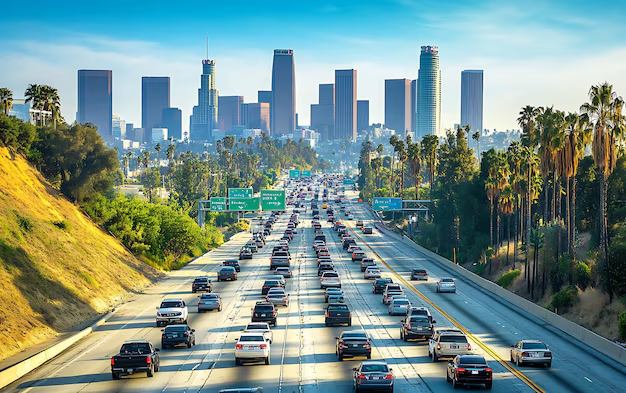
The Downtown Connector (I-75/85), I-285 (the Perimeter), I-20, and GA-400 are the main arteries of metro Atlanta — and where many of the most serious crashes happen.
Common issues:
Fast flow + sudden slowdowns
Traffic may move well over the posted limit, then slam to a crawl near bottlenecks like Downtown, Midtown, or interchanges (I-285/400, I-20/75/85).Weaving and last-second exits
You’ll see drivers cut across multiple lanes to make exits at the last moment. This is especially intense near interchanges like Freedom Parkway, Buford Spring Connector, and 10th/14th Street.Truck traffic
I-285 and I-20 see heavy commercial truck volumes. In bad weather or rush hour, that increases both stress and risk.
How to stay safe on Atlanta interstates:
- Plan your exits ahead of time. Use navigation and get into the correct lane early.
- Avoid far-left lanes if you’re not comfortable cruising at higher speeds and reacting quickly.
- Give big trucks space. They’re common and can’t stop as quickly.
- If you’re new, avoid rush-hour experiments on the Connector and Perimeter until you’ve had some off-peak practice.
2. Potholes, Rough Pavement, and Work Zones
Atlanta’s combination of heavy traffic + rain + temperature swings means pavement takes a beating. You’ll find:
- Potholes on city streets, particularly after winter and heavy rain
- Rough railroad crossings in certain industrial areas and older neighborhoods
- Frequent utility cuts and patchwork resurfacing as water, gas, and telecom work is done
In the City of Atlanta, ATLDOT has been doing more resurfacing and safety projects, but not every corridor is smooth yet — especially in older parts of Southwest, Southeast, and the Westside.
What you can do:
- Scan ahead for potholes instead of staring just past your bumper, especially at night and in rain.
- Report major potholes and dangerous conditions through ATL311 (app or website). That’s the standard channel for city streets.
- In other cities like Sandy Springs or Brookhaven, use their specific service request portals to report issues.
3. Aggressive and Distracted Driving
A big part of “are the roads safe?” in Atlanta is really: “how do people drive here?”
Patterns you’ll quickly notice:
- Tailgating and speeding on multi-lane roads and interstates
- Rapid lane changes with minimal signaling
- Red-light running in parts of the city; don’t assume “green means go” the instant it changes
- Phone use, despite Georgia’s Hands-Free Georgia Act, which prohibits holding your phone while driving
Local law enforcement — Atlanta Police Department (APD) inside city limits and various municipal and county agencies elsewhere — do issue citations for hands-free and speed violations, but enforcement will feel uneven as you move around metro Atlanta.
How to respond as a driver:
- Build in extra time so you’re not tempted to drive like everyone else just to stay on schedule.
- At lights, count a beat before entering the intersection in case someone blows through the red.
- Treat every green left arrow as “people may be running the opposite yellow.”
- Use defensive spacing — don’t let tailgaters push you into dangerous speeds. If possible, change lanes and let them pass.
4. Weather: Rain, Flooding, and Rare but Serious Ice
Atlanta’s climate is usually easy for driving, but extreme events cause outsized problems:
Heavy rain and flash flooding
Storms can quickly pond water on I-285, I-20, and low-lying streets. Older drainage systems struggle during downpours, and some underpasses can briefly flood.Ice and snow (even light amounts)
Atlanta is not built for ice. A small amount can shut the city down, especially on bridges, overpasses, and hills. GDOT and local agencies do pretreat major routes when they can, but if ATLDOT, APD, or GDOT are telling people to stay off the roads, they mean it.
Practical safety steps:
- If a winter storm is forecast, assume your commute may not be realistic. Many employers and schools switch to remote or close.
- In heavy rain, avoid “turn around, don’t drown” situations — if water covers the road and you can’t see the markings, don’t drive through.
- Give extra following distance in any wet or cold conditions; a lot of drivers don’t adjust their speed.
5. Pedestrians, Cyclists, and the BeltLine
Inside the City of Atlanta — especially around:
- Midtown
- Downtown
- Old Fourth Ward
- Inman Park
- West Midtown / Westside
- Grant Park / Cabbagetown
— there’s a growing mix of drivers, scooters, cyclists, and pedestrians, especially near the Atlanta BeltLine and MARTA stations.
You’ll see:
- Mid-block crossings near restaurants, bars, and BeltLine access points
- Cyclists using bike lanes where available, but sometimes taking the lane on streets without facilities
- Scooters and e-bikes darting through traffic or on sidewalks, especially near Georgia Tech, Midtown, and Downtown
ATLDOT, in partnership with the Atlanta BeltLine and other agencies, has added protected bike lanes, traffic-calming measures, and crosswalk upgrades in some areas, but not everywhere.
Driver safety habits in mixed-use areas:
- Expect people to cross where it’s convenient, not always where it’s marked.
- When turning right on red, check for cyclists in bike lanes and pedestrians in the crosswalk.
- Around BeltLine crossings (e.g., on Irwin, 10th, or Memorial), assume people may appear from behind parked cars or walls.
Neighborhood-Level Differences: Not All “Atlanta” Drives the Same
Because of metro Atlanta’s patchwork of cities and counties, “how safe are the roads?” changes when you cross a city limit — even if your mailing address still says “Atlanta.”
A few patterns:
Intown City of Atlanta (Midtown, Old Fourth Ward, West End, East Atlanta inside city limits)
- More pedestrians, scooters, bikes
- More road diets and traffic-calming projects from ATLDOT
- Parking, alleyways, and narrow side streets that can feel tight
Buckhead & North Atlanta inside city limits
- Heavy congestion on Peachtree, Roswell Road, Lenox Road, Piedmont
- Aggressive driving at rush hour, especially near GA-400 and I-85 interchanges
- Lots of commercial driveways (malls, shopping centers) with frequent turn-ins and turn-outs
Suburban cities with “Atlanta” addresses (Sandy Springs, Brookhaven, Chamblee, College Park, East Point, etc.)
- Their own police and road departments
- Some have strict speed enforcement near schools and neighborhood cut-throughs
- Different design standards for sidewalks, bike lanes, and crosswalks
Outer county areas (South Fulton, unincorporated DeKalb, parts of Cobb and Clayton with Atlanta ZIP codes)
- More two-lane roads with higher speeds and fewer sidewalks
- Limited lighting on some stretches
- Bigger gaps between signals and crosswalks, making pedestrian safety an issue
Before you move:
Pull up your exact address in a map, zoom in, and look at:
- Number of lanes on your main routes
- Presence (or absence) of sidewalks and bike lanes
- How you get to the nearest MARTA station or highway entrance
It will tell you a lot about what “safe” and “realistic” driving looks like in that specific part of metro Atlanta.
Law, Enforcement, and Insurance: The Safety Backdrop
Georgia’s Hands-Free Law
Georgia’s Hands-Free Georgia Act makes it illegal to:
- Hold your phone while driving
- Support a phone with your body (like wedged between shoulder and ear)
You can still use:
- Voice commands
- Mounted devices
- Built-in vehicle systems
Police agencies across metro Atlanta — APD, Georgia State Patrol, county sheriffs, and municipal police departments — cite drivers for hands-free violations. Enforcement intensity can vary by jurisdiction and over time.
For relocation planning:
Assume your out-of-state driving habits will be under a bit more scrutiny until you adjust, especially regarding phones and speed.
Insurance and Crash Risk
Auto insurers know that metro Atlanta has a lot of traffic and a fair number of crashes, and their rates reflect that. Whether roads are “safe enough” from an insurance perspective depends on:
- Where your car is garaged (city vs. suburban city vs. unincorporated area)
- Your commuting distance and routes
- Your personal driving record
You can’t change Atlanta’s overall crash statistics, but you can absolutely control your personal risk profile by where and when you drive.
Making Atlanta Roads Safer For Yourself: Practical Strategies
If you’re relocating, everything above may sound daunting. Plenty of Atlantans navigate this every day without constant near-misses. The difference is strategy, not luck.
1. Choose Housing With Your Commute in Mind
When you’re apartment- or house-hunting:
- Map your likely daily routes at your actual commute times.
- Look at options that let you:
- Use arterial roads instead of only interstates, or
- Use MARTA for at least part of the commute (rail from Decatur, East Point, Sandy Springs, or inside I-285), or
- Stagger your hours to miss the worst peaks.
Cities like Decatur, Sandy Springs, and Brookhaven are separate from Atlanta but offer different combinations of traffic patterns, transit access, and local enforcement.
2. Learn Off-Peak First
If you’re not used to dense, high-speed traffic:
- Practice new routes on weekends or mid-mornings before you add rush-hour pressure.
- Try both interstate and surface-street options; sometimes a slightly longer but calmer route is safer and less stressful.
3. Use Technology Wisely
- Keep navigation apps running to avoid wrecks and road closures.
- Use audio directions and a mounted phone to stay legal and distraction-minimized under the hands-free law.
- Check traffic before leaving; small timing changes (even 10–15 minutes earlier or later) can significantly change your stress level.
4. Respect School Zones and Local Rules
Many smaller cities within the metro area — and parts of the City of Atlanta — have:
- Variable-speed school zones
- Strong enforcement around elementary and high schools
- Neighborhood cut-throughs where residents push for speed bumps and stepped-up patrols
If you’re new to an area, pay close attention to flashing school zone signs, crossing guards, and temporary message boards.
So… Are the Roads Safe to Drive On in Atlanta?
If by “safe” you mean calm, orderly, and forgiving, then no — much of metro Atlanta will feel intense compared with smaller cities or regions with less growth.
If by “safe” you mean manageable for a reasonably cautious driver who’s willing to adapt, then yes:
- Interstates are fast but predictable if you plan ahead and avoid peak chaos when possible.
- City streets range from comfortable to chaotic, depending on the neighborhood, but ATLDOT and other agencies are actively working on safety improvements.
- Potholes, aggressive driving, and weather spikes are real issues, but they’re manageable with defensive habits and realistic expectations.
Thousands of people move here every year, adjust to the driving culture, and get around just fine. The key is to treat Atlanta as a serious driving environment, not an easygoing one:
- Give yourself time
- Use transit where it makes sense
- Report hazards through ATL311 or your local city’s equivalent
- And drive like you’re expecting other people to make mistakes — because sometimes, they will.
Do that, and Atlanta’s roads are safe enough to build your daily life around, even if they’ll never be the most relaxing part of living here.