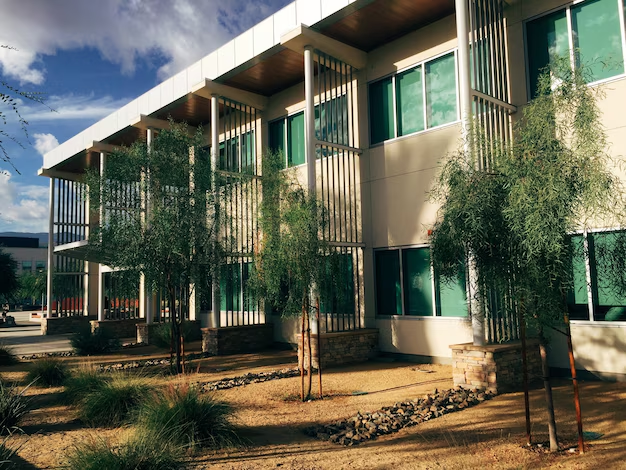
Townhouses in Atlanta: What to Know Before You Rent or Buy
Looking for a townhouse in Atlanta can feel like a smart middle ground between a condo and a single-family home. In many Atlanta neighborhoods, townhomes offer more space than an apartment, less maintenance than a house, and prime in-town locations close to MARTA, parks, and jobs.
This guide walks through how townhouses work specifically in Atlanta, where to find them, common price and layout expectations, key HOA considerations, and practical tips for both renters and buyers.
What Is a Townhouse in Atlanta?
In Atlanta, a townhouse generally means:
- A multi-level home (usually 2–4 stories)
- Attached to neighboring units in a row or cluster
- Often with a private entrance and small yard, patio, or balcony
- Sometimes with a garage, often rear-entry via an alley
- Governed by a homeowners association (HOA) if it’s in a community
Townhouses in Atlanta are especially common in:
- Intown neighborhoods (like Old Fourth Ward, Inman Park, Midtown)
- Close-in suburbs just outside the city limits but functionally “Atlanta” to many residents (like Smyrna, Brookhaven, and parts of Sandy Springs)
- Master-planned communities with shared amenities (pools, dog parks, small playgrounds)
Popular Atlanta Areas for Townhouses
Different parts of Atlanta offer very different townhouse options. Here’s a quick overview:
Intown & In-City Neighborhoods
1. Midtown & Old Fourth Ward
- Why people like it: Walkable to restaurants, BeltLine Eastside Trail, Piedmont Park, Ponce City Market.
- Typical townhouse style: Modern, 3–4 stories, often with rooftop decks and tandem garages.
- Best for: People who want a city feel, nightlife, and walkability.
2. West Midtown & Upper Westside
- Around Howell Mill Road, Marietta Street, and the Upper Westside yards.
- Style: Newer townhome communities with contemporary finishes.
- Best for: Those who like warehouse-style retail, breweries, and quick access to I-75.
3. Grant Park, Reynoldstown, Edgewood
- East-southeast intown neighborhoods.
- Style: Mix of new construction townhomes and small clusters built over the last 10–20 years.
- Best for: Access to the BeltLine Southside/Eastside segments, neighborhood parks, and a residential feel close to downtown.
4. Buckhead
- Around Lenox, Peachtree, and side streets off Roswell Road or Piedmont.
- Style: Both older brick townhomes and luxury gated communities.
- Best for: People who want upscale shopping and dining with easy access to GA-400 and I-85.
Just Outside the Immediate Core
These areas are technically separate cities or suburbs, but many residents still describe them casually as “Atlanta” and commute into the city.
1. Smyrna & Vinings
- Northwest, convenient to I-285 and The Battery/Truist Park.
- Style: Many well-established townhouse communities plus new construction.
- Best for: People wanting suburban feel with good freeway access.
2. Brookhaven
- North of Buckhead.
- Style: Upscale townhome communities, often with brick exteriors.
- Best for: Those who want a balance of urban amenities and quieter streets.
3. Sandy Springs & Dunwoody
- North of the Perimeter.
- Style: Older, more affordable townhomes and newer luxury developments.
- Best for: Proximity to major employers along GA-400 and Perimeter Center.
Townhouse vs. Condo vs. Single-Family Home in Atlanta
For many Atlanta residents, the decision comes down to trade-offs:
| Feature | Townhouse (Atlanta) | Condo (Atlanta) | Single-Family Home (Atlanta) |
|---|---|---|---|
| Ownership structure | Usually includes land under the unit | Usually interior space only (shared building) | House + full lot |
| Maintenance burden | Moderate (HOA covers some, not all) | Lower (HOA often covers more) | Highest (owner handles everything) |
| Outdoor space | Limited (patio, balcony, small yard) | Minimal (balcony, shared spaces) | Most (yard, driveway, possibly large lot) |
| HOA fees | Common, moderate to high | Common, sometimes higher in large buildings | May or may not have HOA |
| Location in Atlanta | Strong intown + close-in suburbs | Strong intown and high-rises | More variety; bigger lots often farther out |
For someone who wants more space than a condo but doesn’t want full yard work responsibility, an Atlanta townhouse is a frequent choice.
Typical Townhouse Layouts in Atlanta
Most Atlanta townhouses follow a few common patterns:
1. Three-Story “Garage on Bottom” Layout
Very common in newer construction:
- Level 1: Garage, foyer, sometimes a bedroom or flex space
- Level 2: Main living area (kitchen, dining, living room, half bath)
- Level 3: Bedrooms and full bathrooms
2. Two-Story Traditional Layout
More common in slightly older communities:
- Level 1: Kitchen, living room, dining, half bath, patio/yard access
- Level 2: Bedrooms and full baths
3. Four-Story with Rooftop Deck
Common in trendy intown locations:
- Levels 1–3: Similar to 3-story layout
- Level 4: Bonus room and rooftop terrace, sometimes with skyline views (Midtown, Downtown, Buckhead)
Renting a Townhouse in Atlanta
If you’re looking for a townhouse for rent in Atlanta, here’s what to watch for:
Where Rentals Show Up
- Individual owners listing their unit in a larger community
- Small local property managers who specialize in intown or townhome communities
- Occasionally, build-to-rent communities where the entire complex is townhouses
Key Questions for Renters
When touring or applying for a townhouse rental in Atlanta, clarify:
- Who manages the property? An individual owner or a management company?
- What’s included in rent? Any utilities, trash, or HOA fees?
- HOA rules: Are there restrictions on:
- Parking (guest parking decals, street parking limits)?
- Pets (breed/weight limits, extra fees)?
- Using the pool, gym, or clubhouse?
- Short-term guests?
Because many renters are moving within metro Atlanta, commute and traffic matter. Test-drive your route at rush hour if possible, especially if you’ll be using I-75, I-85, I-20, or I-285.
Buying a Townhouse in Atlanta
For buyers, townhouse ownership in Atlanta typically means you own:
- Your interior unit
- The exterior walls and sometimes the small yard/lot (varies by community)
- Shared interest in common areas through the HOA
Work With an Agent Who Knows Intown & Townhomes
Not every real estate agent specializes in attached housing. It helps if your agent:
- Understands HOA documents, townhome resale disclosures, and assessments
- Knows which Atlanta communities have healthy reserves and good upkeep
- Can flag rental caps if you might want to rent the unit out later
Many buyers focus on:
- Proximity to MARTA (especially in Midtown, Buckhead, Sandy Springs)
- Access to the Atlanta BeltLine
- Commute times to Downtown or Perimeter job centers
- School clusters if that matters to you (APS, DeKalb, Fulton, Cobb, etc.)
Understanding HOAs in Atlanta Townhouse Communities
Most Atlanta townhouses sit inside an HOA (Homeowners Association). This can be a big positive but also introduces rules and extra monthly costs.
What HOAs Commonly Cover
In Atlanta townhouse communities, HOA dues may include:
- Exterior building maintenance (roof, siding, gutters, sometimes windows)
- Landscaping and lawn care for common areas, sometimes front yards
- Amenity upkeep: pool, clubhouse, fitness room, playground, dog park
- Trash and recycling (depending on if the city or private hauler is used)
- Common area insurance (you still need your own policy)
Every community is different, so review:
- Declaration of Covenants, Conditions, and Restrictions (CC&Rs)
- Bylaws
- Rules and regulations
What to Look For as a Buyer or Renter
Before committing to a townhouse in Atlanta, pay attention to:
- Monthly HOA fee and what it covers
- Reserve funds and whether there have been special assessments
- Policies on short-term rentals (Airbnb, etc.)
- Parking rules (especially guest parking and overnight street parking)
- Noise, grilling, and exterior changes (paint colors, landscaping, security doors)
If you’re buying, your lender and closing attorney will usually request the official HOA documents. Many communities use property management companies located in metro Atlanta.
Townhouse Parking & Transportation Realities in Atlanta
Atlanta is still very car-dependent, and townhouse communities reflect that.
Parking Considerations
- Many townhomes have 1–2 car garages plus a driveway.
- Guest parking may be limited and tightly enforced, especially in gated communities.
- In dense intown neighborhoods, street parking may require permits or be time-limited.
Ask these questions:
- How many assigned spaces come with the unit?
- Are there guest spaces, and do guests need passes?
- Are commercial vehicles or oversized trucks restricted?
Access to MARTA & Commuting
If you want to combine townhouse living with transit access:
- Look for townhomes near MARTA rail stations like:
- Midtown, North Avenue, Inman Park/Reynoldstown, Edgewood/Candler Park
- Lindbergh Center (Buckhead area)
- Medical Center, Dunwoody, Sandy Springs (north line)
- Consider proximity to MARTA bus routes if you don’t want to drive daily.
- Check typical commuting times on I-75/I-85, GA-400, or I-285 if you’ll be driving at peak hours.
Townhouse Amenities Common in Atlanta
Amenities vary by community, but in metro Atlanta you’ll frequently see:
- Swimming pools (especially in larger suburban developments)
- Clubhouses or community rooms
- Small fitness centers
- Gated entrances with call boxes or key fobs
- Dog parks or small fenced pet areas
- Direct or near access to:
- The Atlanta BeltLine
- Neighborhood parks (like Piedmont Park, Grant Park, Chastain Park, or smaller city parks)
A more urban, intown townhouse may offer less in-complex amenity space but more nearby restaurants, bars, and cultural attractions.
Taxes, Utilities, and City Services for Atlanta Townhouses
Property Taxes
If you own a townhouse within the City of Atlanta, your property taxes are set by:
- The county (Fulton or DeKalb, depending on location)
- The City of Atlanta
- Possibly school systems and other local districts
For general information:
- Fulton County Tax Commissioner
- 141 Pryor St SW, Atlanta, GA 30303
- Phone: 404-613-6100
- DeKalb County Tax Commissioner
- 4380 Memorial Drive, Decatur, GA 30032
- Phone: 404-298-4000
If the townhouse is in an area like Sandy Springs, Brookhaven, Smyrna, etc., you’ll pay taxes to that municipality and county instead of the City of Atlanta.
Water, Sewer, Trash
Inside the City of Atlanta:
- Water & Sewer: Typically through City of Atlanta Department of Watershed Management
- 72 Marietta St NW, Atlanta, GA 30303
- Customer service line commonly available for billing questions.
- Trash & Recycling: Usually handled by City of Atlanta Department of Public Works for properties within city limits, unless the townhome community has private service through the HOA.
Some townhouse HOAs bundle trash collection (and occasionally water) into dues. Always ask what utilities you are responsible for directly.
Pet Policies in Atlanta Townhouse Communities
Atlanta is generally pet-friendly, but townhouse rules vary.
Things to check:
- Breed or weight limits for dogs
- Maximum number of pets allowed
- Required pet deposits or fees (for rentals)
- Leash rules and designated pet areas
- Whether fencing is allowed if you want a small private yard
Intown communities near the BeltLine or major parks are especially attractive for dog owners, but they may have more strict HOA enforcement around leashing, noise, and waste pickup.
Safety, Noise, and Community Feel
Townhouse living in Atlanta ranges from quiet, suburban-style clusters to busy, urban-feeling rows steps from nightlife.
Consider:
- Noise levels: Near major streets, bars, or train tracks
- Lighting and security features: Gated entries, cameras at entrances, well-lit parking
- Walkability at night: Sidewalks, streetlights, and regular foot traffic
For concerns or questions about crime and safety in the City of Atlanta, residents often reference information shared by the Atlanta Police Department (APD) or neighborhood associations. APD’s main non-emergency contact line is typically available via the City of Atlanta directory.
Practical Steps to Find a Townhouse in Atlanta
Here’s a simple sequence to follow:
Define your priority:
- Short commute?
- Being close to BeltLine or MARTA?
- School district?
- Budget?
Pick 2–3 target areas:
- For urban lifestyle: Midtown, Old Fourth Ward, Inman Park, West Midtown.
- For more suburban feel: Smyrna/Vinings, Brookhaven, Sandy Springs, parts of Decatur.
Decide: Rent or Buy
- Renting first can help you learn which area fits you best.
- Buying makes more sense if you plan to stay in Atlanta longer term and want stability.
Tour at different times of day
- Visit during rush hour, evenings, and weekends to get a real sense of:
- Traffic and parking
- Noise
- Community activity
- Visit during rush hour, evenings, and weekends to get a real sense of:
Ask specific questions
- HOA fees and rules
- Parking and guest policies
- What utilities and services are included
- Any upcoming assessments or construction plans
Review all documents before signing
- For renters: lease + any addenda related to HOA rules.
- For buyers: HOA covenants, bylaws, rules, budget, and recent meeting minutes if available.
When a Townhouse in Atlanta Makes Sense
A townhouse in Atlanta often fits well if you:
- Want low-to-moderate maintenance but more space than a condo
- Prefer being close to the city without a full yard to manage
- Like the idea of shared amenities and a sense of community
- Don’t mind HOA rules and monthly dues
By focusing on the right neighborhoods, thoroughly understanding HOA expectations, and realistically evaluating commute, parking, and lifestyle, you can narrow down the Atlanta townhouse options to those that genuinely match how you want to live in the city.