
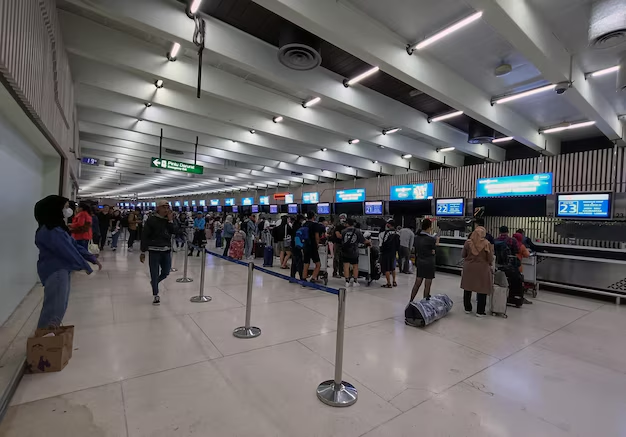
Navigating Atlanta’s Hub Airport: A Local Guide to Hartsfield-Jackson
If you hear people talk about the Atlanta hub airport, they’re almost always referring to Hartsfield-Jackson Atlanta International Airport (ATL). Whether you live in metro Atlanta, you’re flying in for a visit, or you’re just connecting through, understanding how this massive hub works can save you time, stress, and money.
This guide walks you through ATL from a local’s perspective—how it’s laid out, how to get there from different parts of the city, where to park, how to get between terminals, and what to expect as a passenger using Atlanta’s main air travel hub.
What Makes Atlanta a ��Hub Airport”?
Atlanta is one of the busiest air travel hubs in the world. For travelers, that means:
- Huge flight network: Nonstop flights across the U.S. and to many major international cities.
- Major airline hub: Atlanta is a primary hub for Delta Air Lines, with many connecting flights passing through ATL.
- Heavy connecting traffic: A large portion of passengers never leave the airport—they’re connecting between flights.
If you live in metro Atlanta, this hub status means:
- Often more daily flight options than smaller regional airports
- Frequent early morning and late-night departures/arrivals
- Competition on some routes that can help keep fares relatively reasonable
- At times, crowds and long lines, especially during holidays and peak hours
Basic Facts: Location, Terminals, and Contacts
Airport Name: Hartsfield-Jackson Atlanta International Airport
Airport Code: ATL
Main Address:
6000 N Terminal Parkway
Atlanta, GA 30320
General Information Phone:
(800) 897-1910 (commonly listed airport information line)
Quick Layout Overview
ATL is organized in a way that’s different from some other major U.S. airports:
Two main terminal areas at ground level on opposite sides of the building:
- Domestic Terminal – North & South
- International Terminal – Maynard H. Jackson Jr. International Terminal
Concourse system for gates, running east–west:
- Concourse T (connected to Domestic Terminal)
- Concourses A, B, C, D, E, and F
- Concourse F is directly attached to the International Terminal
All domestic and international gates are connected inside security by the Plane Train (underground train) and walkable pedestrian tunnels.
Domestic vs. International: Which Terminal Do You Use?
Domestic Terminal (North & South)
If you’re flying within the United States, you’ll usually use the Domestic Terminal:
- Domestic Terminal – South:
- Main check-in area for Delta Air Lines domestic flights
- Domestic Terminal – North:
- Check-in for many other domestic carriers (for example, Southwest, Frontier, Spirit, etc.)
Your airline determines whether you go to North or South—always check your reservation.
International Terminal (Concourse F)
If you’re:
- Departing from Atlanta on an international flight, or
- Arriving from overseas and Atlanta is your final stop,
you’ll often use the International Terminal at Concourse F.
Key points:
- Has its own entrance and parking off I-75 (separate from the Domestic side).
- Handles check-in, security, and customs/immigration for many international flights.
- Some international flights may use Concourse E but are still connected to the International Terminal via the secure corridor and Plane Train.
Getting to Atlanta’s Hub Airport from Around the City
By Car
ATL is on the south side of the city, directly accessible from:
- I-85 (for the Domestic Terminal)
- I-75 via the International Terminal exit
Rough drive times in normal traffic:
| Starting Area | Approx. Drive Time to ATL |
|---|---|
| Downtown Atlanta | 15–20 minutes |
| Midtown | 20–25 minutes |
| Buckhead | 25–35 minutes |
| Decatur | 25–35 minutes |
| Sandy Springs / Dunwoody | 30–45 minutes |
| Marietta / Cobb County | 35–50 minutes |
| Stone Mountain area | 35–50 minutes |
| Fayetteville / Peachtree City | 30–45 minutes |
⏰ Tip: During weekday rush hours (roughly 7–9 a.m. and 4–7 p.m.), add a generous buffer. I-75 and I-85 can back up quickly.
By MARTA Train
For many Atlanta residents and visitors, MARTA is the easiest way to reach the airport.
- The Airport MARTA Station is located inside the Domestic Terminal, near the baggage claim area.
- It is the southern end of the Red and Gold rail lines.
From common areas:
- Downtown (Five Points): about 15–20 minutes
- Midtown (Arts Center, Midtown): around 20–25 minutes
- Buckhead (Lenox, Buckhead): around 30–35 minutes
- Doraville or North Springs: closer to 40–45 minutes
If you’re using MARTA and flying internationally:
- You’ll arrive at the Domestic Terminal and can:
- Go through security there and take the Plane Train to your international gate, or
- Use the free shuttle from Domestic to the International Terminal (if you need to check in at the International side).
By Rideshare or Taxi
Rideshare pick-up areas for services like Uber and Lyft are clearly marked:
- For Domestic flights, follow signs to the Rideshare pick-up zone (located outside the terminal, usually a short walk from baggage claim).
- For the International Terminal, rideshare picks up just outside the arrivals level.
Taxis line up outside both the Domestic and International Terminals, with flat-rate pricing to many in-town neighborhoods posted at the airport.
Parking at ATL: Options for Different Needs
Atlanta’s hub airport offers several types of parking. Costs can change, but the main categories stay consistent.
Main Parking Types
Hourly Parking (closest to terminals)
- Best for quick pick-ups, drop-offs, and short visits
- Located in decks at both Domestic and International Terminals
- Most expensive daily option
Daily Parking
- Decks a bit further from the terminal than Hourly
- Good for trips of a few days where convenience matters
Economy Parking
- Surface lots that are more budget-friendly
- Served by walkways or airport shuttles
Park-Ride Lots
- Remote lots with shuttle buses to the terminals
- Often better for longer trips where cost is a priority
Cell Phone Lots (free)
- For drivers waiting to pick someone up
- Park for free and wait until your passenger calls to say they’re curbside
Locals often use off-airport private parking services as well, but the official airport lots are typically the simplest first choice, especially if you’re not a frequent flyer.
Inside the Airport: Security, Trains, and Concourses
Security Checkpoints
The busiest spot for most local travelers is security at the Domestic Terminal.
Domestic Main Checkpoints:
- One set on the North side, one on the South
- You can generally use either checkpoint even if your airline uses the other side; it all leads to the same concourse system.
International Terminal Checkpoint:
- Separate security screening area mainly for international departures
If you have programs like TSA PreCheck or CLEAR, these services have dedicated lines at ATL, usually at the main checkpoints.
⏱️ Local tip: Atlanta residents catching early morning flights often aim to arrive at least 2 hours before domestic departures and 3 hours before international flights, especially during school breaks and holidays.
Getting Around: Plane Train & Walkways
Once you pass security, ATL’s concourses are lined up in a row, served by:
Plane Train (Automated People Mover):
- Underground train that stops at:
- Domestic Terminal (Concourse T)
- Concourses A, B, C, D, E, F
- International Terminal
- Trains run frequently; rides between adjacent concourses are just a couple of minutes.
- Underground train that stops at:
Underground Walkway:
- Long pedestrian tunnel with moving walkways and art installations
- Good option when the train is crowded or you prefer to walk off some sitting time
If you’re connecting through Atlanta, you do not usually have to exit and re-clear security; just follow signs to your next concourse/gate.
Arriving in Atlanta: Baggage Claim, Ground Transport, and Customs
Domestic Arrivals
If Atlanta is your final stop on a domestic flight:
- Deplane and follow signs for Baggage Claim / Ground Transportation.
- Take the Plane Train to Baggage Claim (Domestic Terminal – North or South).
- Pick up your bags at the carousel listed on the monitors.
- Choose how you’re leaving:
- MARTA (inside the Domestic Terminal, near baggage claim)
- Rideshare pick-up zones
- Taxi stands
- Rental car center shuttle
International Arrivals
For international passengers whose final destination is Atlanta:
- You’ll go through U.S. Customs and Border Protection at either Concourse F or Concourse E, depending on flight.
- Collect checked luggage and clear customs/immigration.
- If Atlanta is your final stop, you’ll exit into the International Terminal arrivals area.
- Ground transport options from the International side include:
- Rideshare and taxi zones
- Shuttles to the Domestic Terminal and the Rental Car Center
- Hotel shuttles (for nearby airport hotels)
If you’re connecting in Atlanta to another domestic flight, you’ll typically:
- Clear customs and immigration, then
- Re-check bags at the transfer area (if applicable) and
- Go back through security for your next flight and ride the Plane Train to the correct concourse.
Rental Cars and Other Ground Transport
Rental Car Center (RCC)
The Rental Car Center is a separate facility just west of the main terminals.
- Reached via the ATL SkyTrain, an elevated train located outside the Domestic Terminal near the MARTA station.
- The SkyTrain is free, runs frequently, and takes only a few minutes.
Most major rental car companies operate out of the RCC, making it straightforward for both locals and visitors to pick up or drop off vehicles.
Shuttle Buses and Hotel Shuttles
- Numerous airport hotels around Hartsfield-Jackson offer free shuttle buses, typically picking up passengers at the Ground Transportation area.
- Some parking lots, off-site rental companies, and conference facilities also run their own shuttle services.
Services and Amenities Useful to Atlanta Travelers
Because ATL is such a major hub, it offers a wide range of amenities that matter whether you’re a frequent flier or an occasional traveler.
Food and Shopping
- Local and national restaurant brands spread across all concourses and terminals.
- Options range from quick grab-and-go to sit-down restaurants, including some names familiar to Atlanta residents.
- Newsstands, convenience shops, bookstores, and specialty retail throughout the concourses.
Business and Work Needs
- Free Wi-Fi throughout the airport (network name typically includes “ATL”).
- Multiple charging stations at or near many gates.
- Several concourses offer quiet workspaces or seating areas where you can open a laptop more comfortably.
Accessibility
ATL is generally designed to accommodate:
- Travelers using wheelchairs or mobility devices
- Passengers who are blind or low-vision (with audio announcements and signage)
- Families with small children and strollers
If you or a family member need assistance:
- You can request wheelchair or escort services through your airline when booking or before check-in.
- Elevators, ramps, and accessible restrooms are available in all terminals and concourses.
Tips for Atlanta Residents Using Their Home Hub
If you live in or near Atlanta and use ATL regularly, a few local habits can make your life easier:
Know your side of town and route options.
- If you’re southeast or east of the city and flying internationally, the International Terminal entrance off I-75 may be faster than going to the Domestic Terminal.
- If you’re on the north or west side, I-85 to the Domestic Terminal is often more direct.
Consider MARTA for peak travel days.
- For holiday weekends, big events, or Monday morning rushes, MARTA can be more predictable than driving and parking.
Arrive early for morning flights.
- Many Atlanta-based travelers book early departures; security can be busiest between about 5:30–8:30 a.m.
Use the less-busy checkpoints when possible.
- If one side of the Domestic Terminal looks crowded (North vs. South), you can often use the other. Inside, it all connects.
Plan extra time for weather days.
- Atlanta’s thunderstorms and occasional winter weather can cause delays that ripple through the entire hub; giving yourself a buffer reduces stress.
When You Need Help at the Airport
For real-time assistance while you’re at ATL:
- Information Desks: Located in both terminals and some concourses, staffed to answer passenger questions.
- Uniformed airport or airline staff: Can help direct you to gates, baggage claim, ground transport, and services like lost and found.
- Airport Information Line:
- Commonly listed as (800) 897-1910 for general information about the airport.
If your issue involves tickets, delays, cancellations, or baggage problems, go directly to your airline’s customer service counter near check-in or at your concourse.
Understanding how Atlanta’s hub airport is laid out—and how it connects to the rest of the city—makes travel much smoother. Whether you’re an Atlanta local flying out for business, a visitor starting your trip here, or a passenger connecting through the world’s busiest airport, knowing these basics helps you move confidently through Hartsfield-Jackson.