
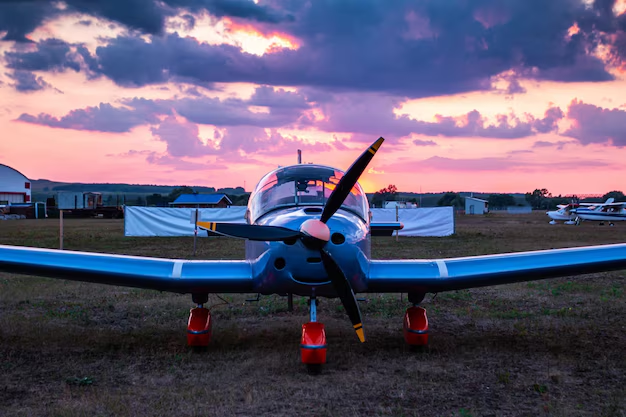
PDK Airport Atlanta: Your Local Guide to DeKalb–Peachtree Airport
If you live in the Atlanta area or you’re visiting and keep hearing people mention “PDK”, they’re talking about DeKalb–Peachtree Airport, a busy general aviation airport just northeast of downtown. It’s not a commercial airline hub like Hartsfield–Jackson, but it plays a big role in Atlanta’s air travel, business aviation, and flight training scene.
This guide walks you through what PDK Airport in Atlanta is, where it is, what happens there, and how locals actually use it.
What Is PDK Airport in Atlanta?
DeKalb–Peachtree Airport (PDK) is a public general aviation airport in Chamblee, serving the greater Atlanta area. It’s the second-busiest airport in Georgia after Hartsfield–Jackson, but:
- It does not handle regular commercial airline service.
- It mainly supports private jets, corporate aircraft, charter flights, flight training, air ambulance, and government aircraft.
For Atlanta residents, PDK is the airport you notice when you see business jets and small planes flying relatively low on the north side of town.
Basic identity:
- Name: DeKalb–Peachtree Airport
- Common name: PDK Airport or simply “PDK”
- Location: Chamblee, in northern DeKalb County, just inside I‑285
- Owner/operator: DeKalb County
Where Is PDK Airport Located?
PDK is conveniently positioned for many north metro Atlanta neighborhoods.
Address:
- DeKalb–Peachtree Airport (PDK)
2000 Airport Road
Atlanta, GA 30341
Even though the mailing address uses “Atlanta,” the airport physically sits in Chamblee, near Brookhaven, Doraville, and Dunwoody.
Nearby landmarks and neighborhoods
You’re close to PDK if you’re around:
- Peachtree Boulevard (SR 141) corridor
- I‑285 & Peachtree Industrial Boulevard
- Chamblee and Doraville city centers
- Brookhaven (especially the north side)
- Perimeter Center / Dunwoody (a short drive up I‑285)
From Downtown Atlanta, PDK is roughly a 20–30 minute drive in typical traffic, often shorter on weekends or off‑peak.
What Happens at PDK Airport?
Most day-to-day action at PDK falls into a few main categories:
1. Business and corporate aviation
Many Atlanta-area companies use PDK for corporate jets and charter flights. For business travelers, PDK can be more:
- Convenient than Hartsfield–Jackson if offices or homes are in Buckhead, Brookhaven, Chamblee, or Dunwoody
- Efficient, with quicker boarding, shorter ground times, and dedicated terminals known as FBOs (fixed-base operators)
You might see:
- Private jets parked on the ramps
- Chauffeured vehicles pulling up to small terminals
- Charter clients boarding away from the main crowds
2. Flight training and pilot schools
PDK is one of the major flight training hubs in the Atlanta region. If you’re interested in becoming a pilot or taking flying lessons near Atlanta, PDK is often one of the first places people look.
Expect to see:
- Single-engine training aircraft constantly taking off and landing
- Pattern traffic (aircraft practicing takeoffs and landings)
- Flight schools offering discovery flights, private pilot training, instrument rating, and beyond
This training activity is a big reason you may notice repetitive small-plane noise in nearby neighborhoods.
3. Charter and air taxi flights
While you cannot book a Delta or Southwest flight out of PDK, you can:
- Arrange on-demand charter flights (turboprop or jet)
- Use air taxi services for shorter regional hops
- Book medical transport or air ambulance operations when needed
These services are typically coordinated through FBOs or specialized aviation companies on the field.
4. Government, military, and emergency services
PDK supports:
- Law enforcement aviation units
- Air ambulance and medical flights
- Occasional military or National Guard movements
- Government aircraft transporting officials
For Atlanta residents, this means the airport can be an important emergency and public safety resource, not just a business and private airport.
PDK vs. Hartsfield–Jackson: What’s the Difference?
Many people new to Atlanta wonder how PDK compares to Hartsfield–Jackson Atlanta International Airport (ATL).
Here’s a quick comparison for everyday use:
| Feature | PDK Airport (DeKalb–Peachtree) | Hartsfield–Jackson (ATL) |
|---|---|---|
| Main purpose | General aviation (private, corporate, training) | Commercial airline hub |
| Airlines | None | Major U.S. and international airlines |
| Typical passenger | Private/charter flyers, pilots, trainees | Public commercial passengers |
| Location | Chamblee / North Atlanta | South of downtown Atlanta |
| Security screening (TSA) | Generally no TSA checkpoints for GA users | Full TSA screening required |
| Best for local residents | Learning to fly, private jet/charter, aviation events | Domestic and international airline travel |
If you are booking a standard commercial flight, you will use Hartsfield–Jackson (ATL), not PDK.
If you are learning to fly, chartering a private aircraft, or working in business aviation, PDK is highly relevant.
Getting to and from PDK Airport
Because PDK is small compared with ATL, navigation is simpler, but there are a few things to know.
Driving directions
PDK is easily accessed from Peachtree Boulevard and I‑285.
From Downtown Atlanta:
- Take I‑85 North.
- Exit to North Druid Hills Road or I‑285 West, then head toward Peachtree Industrial Boulevard / Peachtree Boulevard.
- Follow signs to Peachtree Boulevard (SR 141) and look for airport signage near Chamblee.
From Perimeter / Dunwoody:
- Take I‑285 East.
- Exit at Peachtree Industrial Boulevard / Peachtree Boulevard.
- Head south on Peachtree Boulevard and follow signs to the airport.
Parking policies and exact entrances can vary depending on whether you’re going to an FBO, the airport administration office, or a restaurant on the field, so it’s useful to confirm with the specific operator you’re visiting.
Public transit options
PDK is not directly on MARTA rail, but you can get relatively close.
Common patterns include:
- Take MARTA Rail to Chamblee Station (Gold Line), then
- Use a rideshare or local bus to reach the airport area along Peachtree Boulevard
Because the airport is spread out and designed primarily for vehicle access, a short rideshare or taxi from MARTA is usually the most practical option.
What Facilities and Services Are at PDK?
Even though PDK doesn’t serve commercial airlines, it still has a range of facilities that matter to pilots, passengers of private flights, and aviation enthusiasts.
Fixed-base operators (FBOs)
FBOs act as the main terminals for private and corporate aviation. They typically offer:
- Passenger lounges and waiting areas
- Pilot lounges and planning rooms
- Aircraft refueling and ground handling
- Hangar and tie-down space
- Rental cars or ground transportation coordination
If you’re flying private in or out of PDK, your trip is usually arranged through one of these FBOs, and they’ll tell you exactly where to park and check in.
Aircraft maintenance and services
PDK supports multiple aviation-related businesses, including:
- Maintenance shops for piston aircraft and jets
- Avionics installers and repair services
- Aircraft detailing and cleaning
- Aircraft management companies that handle operations for owners
For Atlanta-based aircraft owners, PDK is a central hub for keeping aircraft based or serviced locally.
Restaurants and observation spots
Many local residents visit PDK just to watch planes and grab a bite to eat. It’s a popular outing for families and aviation fans in north Atlanta.
You may find:
- On-field restaurants with views of the runway
- Outdoor observation areas where you can see takeoffs and landings
- Parking areas near terminals or restaurants often used informally for plane spotting
These offerings can change over time, so it’s wise to check current hours and availability before planning an outing.
Can You Fly Commercial from PDK?
For most travelers: no.
PDK is not a commercial airline airport, so:
- You won’t find regular airline counters, gate areas, or TSA security lines.
- You cannot purchase a ticket on a major airline to or from PDK.
The main exceptions are:
- Charter flights you arrange directly with a charter company
- Private aircraft you or your organization operates
- Air taxi or shared private services organized by aviation providers
If your goal is typical airline travel, you will need to use:
- Hartsfield–Jackson Atlanta International Airport (ATL) for most flights
- Other regional airports only if your operator specifically uses them
Learning to Fly at PDK
If your interest in “PDK Airport Atlanta” is actually about flight training, PDK is one of the most active spots in the state for that.
Types of training commonly available
Flight schools based at or operating out of PDK often provide:
- Discovery / introductory flights (short lessons where you can try flying with an instructor)
- Private Pilot License (PPL) training
- Instrument Rating (IR)
- Commercial and multi-engine training
- Flight reviews and recurrent training for current pilots
Because PDK has busy, controlled airspace and mixed traffic (jets and props), it offers students experience with:
- Tower communications
- Working around higher-performance aircraft
- Complex airspace near a major city
Things Atlanta students often consider
When choosing a flight school at PDK or elsewhere in metro Atlanta, locals typically compare:
- Drive time from home or work (traffic on I‑285 and I‑85 can be a factor)
- Aircraft fleet condition and availability
- Instructor availability and schedule flexibility
- Cost per hour for aircraft and instruction
PDK’s location makes it attractive if you live in Buckhead, Brookhaven, Chamblee, Doraville, Dunwoody, or north DeKalb/north Fulton.
Noise, Neighborhoods, and Community Issues
Because PDK is close to residential areas, aircraft noise is a common topic for nearby neighborhoods.
What residents typically experience
Depending on where you live relative to the runways and flight paths, you may notice:
- Repeated takeoff and landing noise from training aircraft
- Occasional high-power departures by business jets
- Fluctuations in noise volume based on wind direction, time of day, and traffic levels
Neighborhoods that may be more aware of PDK activity include parts of:
- Chamblee
- Brookhaven
- Doraville
- Unincorporated north DeKalb near Peachtree Boulevard and Clairmont Road
Noise abatement and communication
Airports like PDK generally work with the community through:
- Noise abatement procedures for pilots (recommended routes and altitudes)
- Preferred runways and operation times where feasible
- Community outreach and information channels about airport impacts
If you live nearby and have concerns, common steps include:
- Checking airport or county noise information for maps and explanations
- Contacting airport administration to share feedback or ask about procedures
- Attending local public meetings when airport issues are discussed
This can help you understand what’s normal, what’s changing, and how the airport and county address community concerns.
When Would an Atlanta Resident Actually Use PDK?
If you’re not a pilot or a corporate traveler, you may still interact with PDK in a few practical ways:
- ✈️ Meeting or dropping off someone flying private or on a charter
- 👨✈️ Taking a discovery flight or beginning pilot training
- 👪 Bringing kids or guests to watch airplanes and have a meal with a runway view
- 🏢 Attending a business meeting or event in a conference room at an FBO or airport facility
- 🩺 Coordinating with air ambulance services when specialized transport is needed
PDK is also a recognizable point of reference in north Atlanta for directions and local identity.
Key Takeaways for “PDK Airport Atlanta”
- PDK (DeKalb–Peachtree Airport) is a general aviation airport in Chamblee, serving metro Atlanta.
- It is not a commercial airline airport; no regular airline flights operate from PDK.
- The airport focuses on private, corporate, charter, training, and government flights.
- It’s conveniently located for north metro Atlanta residents and businesses.
- Locals use PDK mainly for flight training, private or charter travel, aviation-related work, and plane-watching outings.
If you live in Atlanta or are visiting and see references to “PDK Airport Atlanta,” you’re dealing with the region’s primary non-airline airport, an important but more behind-the-scenes part of the city’s aviation network.