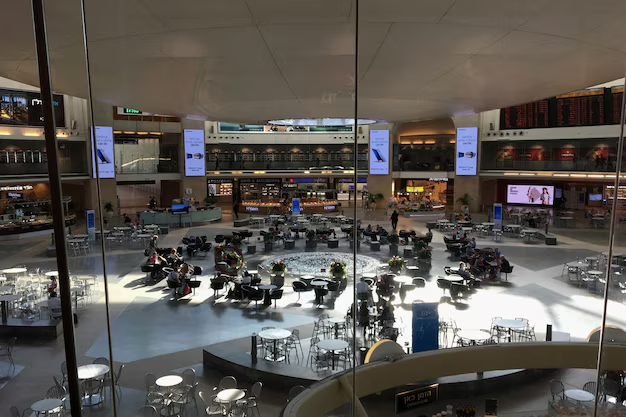
Why Atlanta Has the World’s Busiest Airport: A Local’s Guide to Hartsfield–Jackson
Ask almost anyone in Atlanta what the city is known for, and “the airport” will be near the top of the list. Hartsfield–Jackson Atlanta International Airport (ATL) is often described as the busiest airport in the world, and that’s not just local pride talking.
If you live in Atlanta, are visiting, or are just curious why Atlanta’s airport is so busy, it helps to understand the geography, airline strategy, and local economy that all intersect at ATL.
The Big Picture: Why Atlanta’s Airport Is So Busy
At a high level, Atlanta is busy because it is perfectly positioned to connect people:
- Centrally located in the Southeast United States
- Major hub for one of the world’s largest airlines
- Designed for connections, with multiple runways and concourses
- Backed by a large metro population and strong business travel demand
The result: millions of passengers every year, many of whom never leave the airport but rely on it as a connection point between other cities.
Atlanta’s Strategic Location in the U.S.
One of the biggest answers to “Why is Atlanta the busiest airport?” is geography.
A Natural Crossroads
Atlanta sits at a kind of transportation crossroads for the eastern half of the United States:
- Roughly halfway between the Northeast and Florida
- Easy flying distance to most major U.S. cities east of the Rockies
- A central point for routes across the Southeast, Midwest, and Texas
For airlines, this makes Atlanta an ideal place to:
- Start nonstop flights to many different cities
- Bring passengers into Atlanta and connect them onward to other destinations
This central location has also made Atlanta a rail and trucking hub historically, so the airport is part of a larger pattern: Atlanta is a major transportation city.
The Hub-and-Spoke System: How Airlines Use Atlanta
Another key reason is the way airlines structure their networks, especially with Atlanta as a hub.
What a “Hub” Really Means
In airline terms, a hub airport is a central location where:
- Planes from many cities arrive around the same time
- Passengers transfer to other flights going in many directions
- The airline can combine passengers from different origins onto the same flight
Atlanta is one of the primary hubs for Delta Air Lines, which has a large presence at Hartsfield–Jackson. This drives a huge amount of daily activity.
Why This Makes ATL So Busy
Because ATL is a hub, it handles:
- Local passengers who start or end their journeys in Atlanta
- Connecting passengers who may never visit the city but use ATL to change planes
That second group is massive. If you’ve ever walked through Concourse A, B, or C at peak times, you’ve seen just how many people are only in Atlanta long enough to make a connection.
This hub-and-spoke model concentrates flights through a few key airports. Atlanta is one of the busiest because airlines can:
- Fill more seats by combining passengers from many smaller cities
- Run frequent flights to major destinations
- Use Atlanta as a backup option for rerouting passengers during delays elsewhere
Airport Design: Built to Handle Huge Volume
ATL isn’t just busy by accident. It’s engineered to handle large numbers of flights and people.
Multiple Parallel Runways
Hartsfield–Jackson has multiple parallel runways, which allows:
- Several planes to take off and land at the same time
- More efficient handling of traffic during busy periods
- Better recovery from weather-related delays
This design is a major reason Atlanta can handle a very high volume of daily operations compared with many other airports.
Linear Concourse Layout
If you’ve ever taken the Plane Train under the terminal, you’ve seen ATL’s basic structure:
- Domestic Terminal North and South
- International Terminal (Maynard H. Jackson Jr. International Terminal)
- Concourses T, A, B, C, D, E, and F lined up in a row
This linear layout helps:
- Keep walking distances within each concourse manageable
- Make it easier to move between concourses via train or walking tunnels
- Support clear signage and flow for connecting passengers
For many travelers, Atlanta is known as a place where connections are relatively straightforward, which encourages airlines to schedule even more connecting flights through ATL.
The Atlanta Metro Area: A Large Home Base
Atlanta isn’t just a pass-through point. It is also a major population and business center, which adds to the airport’s traffic.
Local Demand From Metro Atlanta
The Atlanta metropolitan area has millions of residents, reaching far beyond the city proper into places like:
- Marietta
- Sandy Springs
- Decatur
- Alpharetta
- Peachtree City
- Stone Mountain
- Douglasville
These residents use Hartsfield–Jackson as their primary airport for:
- Leisure travel
- Business trips
- Visiting family in other parts of the country or world
So ATL is not only busy with connections; it’s also the main gateway for a big local population.
Business and Convention Travel
Atlanta is known for being a major business hub, with companies and organizations based or heavily present here, often near:
- Downtown Atlanta
- Midtown
- Perimeter Center
- Cumberland/Vinings
- Buckhead
The city frequently hosts conventions, trade shows, and corporate events, especially around the Georgia World Congress Center, Centennial Olympic Park, and hotel clusters in Downtown and Midtown.
This generates:
- Steady business travel to and from Atlanta
- Group travel that may fill flights at certain times of year
- Extra demand around large events like conferences and major sporting events
All of this adds to why Atlanta’s airport stays busy year-round, not just during holidays.
Global Connections and International Traffic
For many travelers in the Southeast, if you’re flying overseas, you’re probably going through Atlanta.
Major International Gateway
Hartsfield–Jackson is a primary international gateway for the region:
- Nonstop flights to Europe, Latin America, and Asia
- Services to major hubs abroad, where travelers connect onward
- Strong ties to partner airlines through alliances and code-sharing
The International Terminal (Concourse F) and Concourse E handle much of this international traffic, with:
- Customs and immigration facilities
- International arrivals and departures
- Easy connections to domestic concourses via the Plane Train
Even many travelers from neighboring states—like Alabama, South Carolina, Tennessee, and parts of Florida—use ATL as their connection point for international travel.
How Atlanta’s Airport Impacts Daily Life in the City
If you live in or near Atlanta, the airport’s size and activity shape local life in several ways.
Jobs and Economic Impact
Hartsfield–Jackson directly and indirectly supports a large number of jobs, including:
- Airline employees
- Airport operations staff
- TSA and customs officers
- Retail and restaurant workers in terminals
- Ground transportation services (taxis, rideshare drivers, shuttle drivers)
- Cargo and logistics workers in nearby warehouses and distribution centers
The airport also influences the growth of surrounding areas like College Park, Hapeville, and East Point, where many airport-related businesses are based.
Transportation Access Around the Airport
Because ATL is so busy, getting to and from the airport is a key concern for locals and visitors.
Common options include:
- MARTA rail: The Airport Station is located inside the Domestic Terminal, making MARTA a popular choice from Downtown, Midtown, and Buckhead.
- Rideshare and taxis: Dedicated pickup areas serve services like ride-hail and traditional taxis.
- Airport parking: On-site parking lots and decks, plus numerous off-airport parking options nearby.
- Rental cars: The Rental Car Center is connected via the SkyTrain from the terminal area.
Because of ATL’s scale, traffic can be heavy around Camp Creek Parkway, I-85, and I-285 near the airport, especially during peak travel times.
What This Means for You as an Atlanta Traveler
For people who live in or travel through Atlanta, the airport’s “busiest in the world” status has both advantages and challenges.
Advantages
- Frequent flight options: More daily flights to popular destinations, often at multiple times of day.
- Competitive pricing: A large, competitive market can help keep some fares relatively reasonable.
- Strong connections: Easy access to many cities without complex, multi-stop itineraries.
- Robust services: Multiple lounges, dining options, shops, and amenities that come with a major hub.
Challenges
- Crowds and lines: Security checkpoints, boarding areas, and concourses can be very crowded at peak times.
- Delays ripple effect: Weather or operational issues elsewhere can quickly affect Atlanta because so many flights connect here.
- Navigation: First-time visitors may find the airport’s size intimidating, even with clear signage.
For Atlanta-based travelers, the best approach is usually to:
- Arrive early, especially at busy times like holidays or Monday mornings
- Learn your way around key areas like security checkpoints, Plane Train stops, and your usual concourses
- Build in extra time for connections, particularly if switching between domestic and international flights
Quick Reference: Why ATL Is So Busy
Here’s a simple breakdown you can skim or screenshot:
| Factor | How It Makes ATL So Busy |
|---|---|
| Central U.S. location | Ideal connecting point for flights across the East and Southeast |
| Major airline hub | Concentrates many flights and connections through one airport |
| Airport design & runways | Multiple parallel runways and linear concourses handle high traffic |
| Large metro population | Millions of residents rely on ATL as their primary airport |
| Business & convention travel | Steady stream of corporate and event-related travelers |
| International gateway | Key departure and arrival point for overseas flights from the Southeast |
| Transportation infrastructure | Strong road, rail, and local transit access supports high passenger flow |
Practical Details: Where Atlanta’s Airport Is and How to Reach It
If you’re planning to use Hartsfield–Jackson, here are core details to know.
Hartsfield–Jackson Atlanta International Airport (ATL)
6000 N Terminal Pkwy
Atlanta, GA 30320
Key points:
- Located about 10 miles south of Downtown Atlanta
- Accessible via I-85, with connections to I-285
- MARTA’s Airport Station is directly attached to the Domestic Terminal
For visitors and locals alike, understanding why Atlanta’s airport is so busy makes its scale and constant activity a lot more understandable. ATL is not just an airport; it’s a major engine of connectivity for Atlanta, the Southeast, and far beyond.