
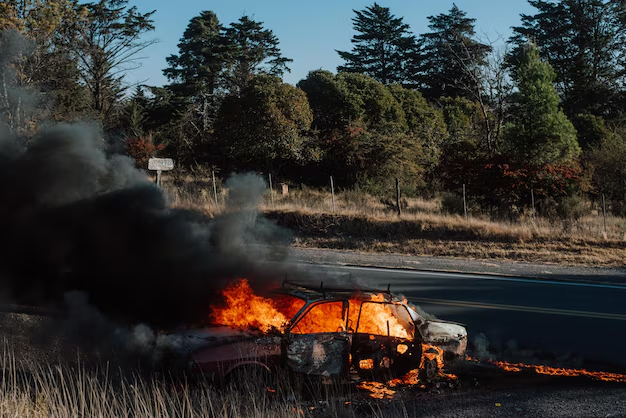
What To Know After a Fatal Car Accident in Atlanta, Georgia
A fatal car accident in Atlanta is devastating for everyone involved — families, witnesses, and even first responders. If you live in the Atlanta area or are dealing with the aftermath of a deadly crash here, you may be overwhelmed and unsure what happens next, legally and practically.
This guide walks through what typically occurs after a fatal crash in Atlanta, Georgia, what families can expect, and what steps people commonly take in the days and weeks that follow.
What Happens Immediately After a Fatal Car Accident in Atlanta
When a serious crash is reported in Atlanta, several agencies and responders typically become involved right away.
1. Emergency response and scene control
At the scene, you can usually expect:
- Atlanta Police Department (APD) officers or other local law enforcement (e.g., DeKalb County Police, Fulton County Police, depending on the location)
- Atlanta Fire Rescue Department and emergency medical services (EMS)
- Possible involvement of the Georgia State Patrol (GSP), especially for major highway crashes
Their priorities are to:
- Secure the scene and prevent additional collisions
- Provide emergency medical care
- Determine if there are fatalities or critical injuries
- Redirect traffic (especially on major roads like I-75/85, I-20, I-285, GA-400, Peachtree Street, or Northside Drive)
If you arrive at or witness a serious crash, calling 911 is the first and most important step.
2. Road closures and traffic impacts
In Atlanta, fatal crashes often lead to extended road closures so investigators can safely work. This is common on:
- Downtown Connector (I-75/85)
- I-20 eastbound or westbound through the city
- I-285 perimeter
- Major surface streets like Peachtree Street, Moreland Avenue, Cobb Parkway, or Campbellton Road
Traffic delays can last hours, and drivers are usually detoured to side streets, which can quickly become congested.
How Fatal Crash Investigations Work in Atlanta
After a fatal collision, the crash is treated as a serious investigation, not just a routine traffic incident.
Which agencies investigate?
Depending on where the accident occurs, investigations may be handled by:
- Atlanta Police Department (APD) – Accident Investigation Unit
- Georgia State Patrol Specialized Collision Reconstruction Team (SCRT) for major or complex crashes
- Nearby city or county departments (e.g., Sandy Springs Police, DeKalb County Police, Fulton County Sheriff’s Office) if the crash is outside APD’s jurisdiction
Each agency gathers information to determine:
- What happened
- Who was involved
- Whether any laws were broken
What do investigators look at?
Investigators typically:
- Take photos and measurements of the scene
- Examine vehicle damage, skid marks, and debris
- Collect witness statements
- Review any nearby traffic camera or security footage
- Check for signs of speeding, distraction, impairment, or mechanical failure
If impairment is suspected, officers may:
- Request breath or blood tests (for surviving drivers)
- Document visible signs of intoxication or drug use
📝 Key point: A fatal crash investigation in Atlanta can take weeks or months. Families often do not receive immediate answers about fault or potential criminal charges.
The Role of the Fulton County Medical Examiner and Coroner Offices
In Atlanta, deaths from car accidents are generally handled by the county medical examiner or coroner, depending on where the crash occurred.
For much of the Atlanta area, this will often involve:
- Fulton County Medical Examiner’s Office
- 430 Pryor Street SW
- Atlanta, GA 30312
- Main phone (commonly listed): 404-613-4400
In adjacent counties:
- DeKalb County Medical Examiner – for crashes in parts of Decatur, Stone Mountain, Tucker, etc.
- Cobb County Medical Examiner – for parts of Marietta, Smyrna, Cumberland area, etc.
- Clayton County Medical Examiner/Coroner – for areas like Forest Park, Riverdale, or near Hartsfield-Jackson
What the medical examiner typically does
The medical examiner’s role usually includes:
- Confirming cause and manner of death
- Identifying the deceased (if not already confirmed)
- Notifying next of kin (often with law enforcement)
- Retaining personal property, which may later be released to families
- Issuing initial and final death certificates
Families may be contacted to:
- Provide identifying information
- Authorize release of the body to a funeral home
- Answer questions about medical or personal background, when relevant
How Families Are Usually Notified in Atlanta
When a loved one dies in a car accident, Atlanta-area law enforcement and medical examiner staff typically work together to make a personal notification.
Common methods include:
- In-person notification by uniformed officers or investigators at the family’s home
- Contact through a listed emergency contact
- Sometimes, contact through another law enforcement agency if family lives outside metro Atlanta or out of state
Families are rarely given detailed investigative conclusions at this stage, as the case is usually still unfolding.
Understanding Criminal vs. Civil Aspects After a Fatal Crash
Many people in Atlanta are confused about the difference between criminal charges and civil claims after a fatal car accident. Both may arise from the same incident, but they serve different purposes.
Criminal side: When the state gets involved
Law enforcement and prosecutors may pursue criminal charges if they believe a driver:
- Was driving under the influence of alcohol or drugs
- Was reckless, such as extreme speeding or street racing
- Left the scene (hit-and-run)
- Drove in a way that shows extreme disregard for human life
In these cases, charges in Georgia may include:
- Vehicular homicide
- DUI-related offenses
- Reckless driving
- Hit and run
Criminal cases are generally handled in:
- Fulton County, DeKalb County, Cobb County, or Clayton County courts, depending on location
- Sometimes Atlanta Municipal Court for related traffic issues
The goal of a criminal case is to determine guilt and punishment, not to pay compensation to the family.
Civil side: Insurance and wrongful death claims
Separately, families often explore civil options. These typically involve:
- Insurance claims with the at-fault driver’s insurance company
- Potential wrongful death or related civil actions, if families choose to pursue that route
Civil matters focus on financial responsibility and compensation, and may involve:
- The at-fault driver’s liability coverage
- The deceased’s own auto insurance, including uninsured/underinsured motorist coverage
- Other potentially involved parties (for example, commercial vehicles or rideshare companies, depending on circumstances)
What Families Commonly Need To Do After a Fatal Car Accident
There is no single “right” order for these steps, but families in Atlanta often find themselves dealing with the following practical tasks.
1. Identifying and choosing a funeral home
Once the medical examiner releases the body, families typically:
- Select a funeral home in Atlanta or another city
- Authorize transport and arrangements
- Coordinate any religious or cultural needs
Funeral homes in and around Atlanta can also help families with death certificates and some of the necessary forms.
2. Obtaining the death certificate
Death certificates in the Atlanta area are normally available through county vital records offices or the Georgia Vital Records Office, often requested via:
- The funeral home
- County health or vital records offices
- State-level vital records services
Many legal and financial processes (life insurance, banking, benefits) require official copies of the death certificate.
3. Getting the police accident report
The official crash report is often essential for insurance, benefits, and any legal or civil processes.
In Atlanta, crash reports may be obtained from:
- Atlanta Police Department – Central Records Unit
- 226 Peachtree Street SW
- Atlanta, GA 30303
- Main non-emergency line often listed: 404-546-5460
OR
- The relevant county or city police department (e.g., DeKalb County Police Records, Cobb County Police Records)
Reports might also be accessible through statewide online systems that many Georgia agencies use for accident reports.
Families usually need:
- The date and location of the accident
- Names of people involved
- The case number, if known
Note: The full investigative file for a fatal accident may not be immediately available, especially if a criminal case is ongoing. Basic crash reports are generally accessible sooner.
4. Notifying insurance companies
If the deceased owned a vehicle or had auto insurance, someone typically needs to notify:
- The deceased’s auto insurance company
- Any other involved insurer, if you are a family member, executor, or otherwise authorized
Information that may be requested:
- Policy number
- Accident date and location
- Police case number
Insurance companies may also ask for:
- A copy of the death certificate
- Contact details for the estate representative or next of kin
Where Fatal Crashes Commonly Occur in the Atlanta Area
In and around Atlanta, fatal car accidents often occur in a few predictable settings:
Interstates and major highways:
- I-75/85 (Downtown Connector)
- I-20 (especially near downtown and West Atlanta)
- I-285 (the Perimeter)
- GA-400, particularly in high-speed segments
Busy surface streets and corridors:
- Peachtree Street/Peachtree Road corridor
- Moreland Avenue, Memorial Drive, Cobb Parkway, Buford Highway
- Areas with frequent lane changes and turning traffic
Intersections with heavy traffic or complex patterns
- Multi-lane intersections
- Areas near Hartsfield-Jackson Atlanta International Airport
- Large commercial areas like Buckhead, Midtown, Downtown, Cumberland, or Perimeter Center
These are not the only locations, but they are common sites for serious and sometimes fatal crashes because of high speeds, congestion, and complex traffic movement.
Common Causes of Fatal Car Accidents in Atlanta
While every collision is different, certain factors appear repeatedly in Atlanta-area fatal crashes:
- Speeding or aggressive driving
- Impaired driving (alcohol or drugs)
- Distracted driving (especially phone use, navigation, or entertainment systems)
- Running red lights or ignoring traffic signals and stop signs
- Improper lane changes on interstates and multi-lane roads
- Pedestrian and cyclist conflicts, particularly in dense intown neighborhoods
Because Atlanta mixes high-speed interstates, crowded surface streets, and rapidly growing development, drivers regularly encounter changing traffic conditions and construction zones, which can also contribute to serious crashes.
If You Witness or Come Across a Fatal or Serious Crash in Atlanta
For drivers and pedestrians in Atlanta, knowing what to do if you encounter a serious crash can save lives and help investigators.
Step-by-step guide for bystanders
Ensure your own safety first
- Pull over to a safe area if possible
- Turn on hazard lights
- Stay off the travel lanes if you can safely do so
Call 911 immediately
- In Atlanta, dialing 911 connects you with local emergency services
- Provide clear details:
- Location (nearby exit, mile marker, major intersection, or landmark)
- Number of vehicles involved
- Whether people appear trapped or unresponsive
Offer help only if it is safe and you feel able
- Avoid putting yourself in danger in active traffic
- Do not move injured people unless they are in immediate danger (for example, a vehicle on fire)
Stay on scene to provide a statement
- If officers ask for your version of events, provide details calmly and honestly
- Witness information can be crucial in later investigations
Avoid posting graphic images or videos online
- Families may not yet have been notified
- Posting identifiable, sensitive content can be deeply harmful to loved ones
Support Resources in Atlanta After a Fatal Accident
After a fatal crash, families and loved ones often need both practical and emotional support.
Here are some types of resources people in Atlanta commonly seek:
Emotional and grief support
- Counseling and grief support groups operated by hospitals, community centers, or faith-based organizations throughout metro Atlanta
- Employee Assistance Programs (EAPs) if a family member or survivor has access through their employer
- Local non-profit organizations that focus on grief, trauma, or loss support
Hospitals in the Atlanta area sometimes connect families with social workers or chaplains who can help with resources immediately following a tragedy.
Practical and everyday support
Families may need help with:
- Childcare or school coordination
- Time off work and workplace communication
- Managing calls from insurance adjusters and related parties
- Transportation if the family vehicle was destroyed or held as evidence
Community networks — neighbors, local religious communities, and community centers — often become critical sources of daily support and assistance.
Quick Reference: Key Steps After a Fatal Car Accident in Atlanta
| Situation | Who Typically Handles It | What Families Often Do |
|---|---|---|
| Emergency response at crash scene | APD, GSP, Fire/EMS | Wait for updates; avoid driving to active scenes unless directed |
| Death investigation | County Medical Examiner/Coroner | Provide identification info; select a funeral home for transfer |
| Road closures and traffic | Law enforcement & GDOT | Check traffic apps or local news; use alternate routes |
| Determining fault & criminal charges | Police investigators, prosecutors | Cooperate with investigators if contacted; stay informed about case status |
| Insurance & financial issues | Auto insurers, life insurers, lenders | Notify insurers; gather documents (policy numbers, reports, death certificate) |
| Emotional and grief support | Counselors, community groups, faith organizations | Reach out for counseling, support groups, or community assistance |
Staying Informed About Fatal Crashes in Atlanta
People in the Atlanta area often stay updated on serious traffic incidents and fatal accidents through:
- Local news outlets and TV stations that cover major crashes and road closures
- Traffic and navigation apps showing extended closures on interstates and primary routes
- Public statements from Atlanta Police Department, Georgia State Patrol, or county sheriff’s offices
Families directly affected by a fatal crash usually receive information more formally through:
- Investigators assigned to the case
- The medical examiner’s office
- Any attorneys or representatives they choose to work with
When a fatal car accident in Atlanta occurs, the impact is wide-ranging: from the immediate emergency response and long traffic delays to complex investigations and grieving families. Understanding how the process typically works in Atlanta — who responds, how investigations unfold, and what steps families often take — can make a very difficult situation a little more manageable, whether you live in the city, commute through it, or are just trying to understand how these tragic events are handled locally.