
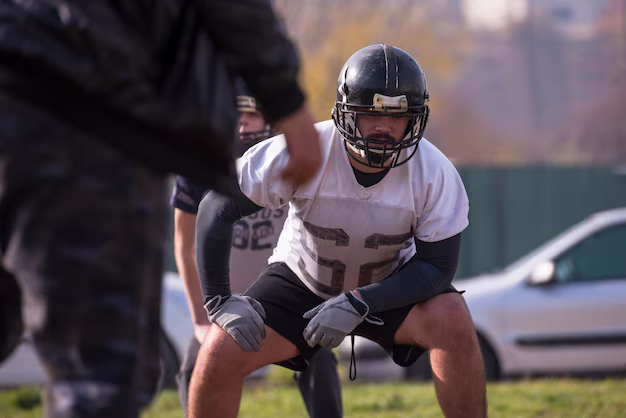
Atlanta Falcons Defensive Line: What Fans in Atlanta Should Know
The Atlanta Falcons’ defensive line (often shortened to “D-line”) is at the heart of how the team plays defense at Mercedes-Benz Stadium. If you live in Atlanta, follow local sports talk, or are heading downtown for a game, understanding how the Falcons’ D-line works will help you make sense of what you’re seeing on the field each Sunday.
Below is a practical, Atlanta-focused guide to what the defensive line does, who to watch, how it fits the Falcons’ identity, and how you can follow and experience it locally.
What the Atlanta Falcons D-Line Actually Does
In simple terms, the Falcons’ defensive line is the group of big, physical players who line up closest to the football on defense. Their main jobs:
- Stop the run – Plug gaps so opposing running backs can’t find lanes.
- Rush the passer – Pressure or sack the quarterback.
- Control the line of scrimmage – Win one-on-one battles to disrupt plays before they start.
In Atlanta’s typical defensive looks, the D-line usually includes:
- Defensive tackles (DTs) – Interior linemen who line up over or near the guards/center.
- Defensive ends (DEs) or edge defenders – Lined up outside the tackles, focusing heavily on pass rush and outside contain.
When you’re watching a game in Atlanta, if you see the quarterback constantly under pressure or the opposing run game getting stuffed near the line, the D-line is doing its job.
How the Falcons’ D-Line Fits the Team’s Identity
Atlanta has gone through different defensive schemes, but a few themes tend to matter for the Falcons’ defensive front:
- Speed and disruption – Atlanta defenses often value quickness and penetration, not just size.
- Versatility – Players who can line up inside and outside give the team flexibility in how it attacks.
- Rotations – Because of the heat and humidity that still hang in the air for early-season home games in Atlanta, the D-line typically rotates heavily to stay fresh, even with the comfort of a climate-controlled dome.
If you listen to local sports radio around Atlanta, you’ll frequently hear discussion about “getting more pressure” or “stopping the run up front” — both are direct critiques or compliments of the D-line.
Key Roles on the Falcons Defensive Line
Even if the names change from year to year, the roles stay fairly consistent. Here’s a quick reference you can use when you’re following the Falcons:
| Position | Where They Line Up | Main Jobs in Atlanta’s Defense |
|---|---|---|
| Defensive Tackle (1-tech/3-tech) | Inside, near the center and guards | Stop the run, collapse the pocket from the inside |
| Defensive End | Outside the offensive tackles | Rush the passer, set the edge vs. outside runs |
| Nose Tackle | Directly over the center (in some looks) | Eat double-teams, control interior run lanes |
| Edge/Hybrid | Wide outside or standing on the edge | Pure pass rush, pressure, sometimes drop into coverage |
When the Falcons have a strong interior presence plus at least one threatening edge rusher, it changes what offensive coordinators are willing to call against Atlanta.
What Atlanta Fans Should Watch for on Game Day
Whether you’re at Mercedes-Benz Stadium or watching from home in Atlanta, here are simple cues to evaluate how the Falcons’ D-line is performing:
1. Run Defense
Ask yourself:
- Is the opposing running back getting hit at or behind the line?
- Are there big holes between the tackles?
- Do Falcons defenders seem to be getting pushed backward?
If you frequently see Falcons linemen meeting the ball carrier quickly and forcing second-and-long or third-and-long, that’s a positive sign.
2. Pass Rush
Key things to notice:
- How often does the opposing quarterback have to move off his spot?
- Are throws coming out faster than usual because of pressure?
- Even if sacks are low, are there hits, hurries, and batted passes?
In Atlanta, you’ll often hear local analysts talk about “affecting the quarterback,” not just racking up sacks. Pressure that forces bad throws can be just as important.
3. Effort and Rotation
During early season home games:
- Watch for how often new linemen cycle in and out.
- Pay attention to pursuit — are big men still chasing plays downfield?
The staff usually tries to keep the D-line fresh, especially when opponents try to use tempo to wear them out.
Experiencing the Falcons D-Line Live in Atlanta
If you’re local or visiting, there are several ways to get closer to the Falcons’ defensive line action.
Mercedes-Benz Stadium (Home Game Experience)
Mercedes-Benz Stadium
1 AMB Drive NW
Atlanta, GA 30313
Here’s how to get the most out of watching the D-line:
- Seat selection:
- Lower-bowl seats behind the end zone can give you a great view of line play as offenses move toward you.
- Seats higher up around the 50-yard line offer a clearer view of line stunts, twists, and blitzes.
- Pregame warmups:
- Get into the stadium early to watch the D-line go through position drills — hand-fighting, sled work, and get-off drills show you their technique up close.
- Third-down defense:
- Pay special attention on 3rd-and-long situations. This is when the Falcons usually deploy their best pass-rush combinations.
Training Camp & Open Practices
Most years, the Falcons hold training camp and some open practices that are accessible from the Atlanta area. These sessions are ideal for:
- Watching individual drills that show technique (hand usage, leverage, footwork).
- Seeing how coaches emphasize gap assignments and run fits.
- Noticing which linemen are working with the first-team defense.
Local sports outlets and the team’s official channels typically share updated schedules, so Atlanta residents can plan a visit.
How the Falcons’ D-Line Impacts the Game in Atlanta
The defensive line affects almost every part of how the game feels at Mercedes-Benz Stadium:
- Noise level – A sack or big stop on third down often triggers the loudest moments in the stadium.
- Momentum swings – Forced fumbles, tipped passes, and stops in the red zone often start with the D-line.
- Complementary football – When the D-line plays well, it:
- Gives the offense more possessions.
- Helps the secondary by forcing quick, rushed throws.
- Helps special teams with better field position.
Locally, when people in Atlanta say the team needs to be “better in the trenches,” they’re usually talking about the offensive and defensive lines. For the Falcons, improvement up front on defense is often framed as a key to making a playoff push.
Following the Falcons Defensive Line From Atlanta
If you want to track the D-line’s progress throughout the season from right here in Atlanta, here are practical ways to do it:
Local TV and Radio
Atlanta’s sports media frequently breaks down the Falcons’ pass rush and run defense:
- Game broadcasts often feature replays showing how the D-line created pressure or lost contain.
- Local radio talk shows on weekday mornings and afternoons regularly discuss:
- Sack totals
- Run defense issues
- Which defensive linemen are trending up or down
When you hear callers or hosts talking about “winning up front,” it’s usually a conversation about the defensive line.
In-Game and Week-to-Week Stats
Common D-line stats that are easy to follow:
- Sacks – Direct takedowns of the quarterback.
- Tackles for loss (TFL) – When defenders hit the ball carrier behind the line.
- Quarterback hits – Even without sacks, consistent hits show ongoing pressure.
- Pressures/hurries – These are sometimes discussed by analysts even if not listed in basic box scores.
As a fan in Atlanta, checking these after each game helps you gauge whether the defensive line is improving over the season.
How Weather, Turf, and Stadium Affect the D-Line in Atlanta
Even though Mercedes-Benz Stadium is a modern, enclosed stadium, Atlanta-specific factors still play a role:
- Climate-controlled environment –
- Helps bigger linemen maintain stamina compared to outdoor, humid conditions.
- Makes the field surface consistent, which can favor quick, explosive pass rushers.
- Early-season heat outside the dome –
- Can matter more in outdoor practices or away games in the region.
- Conditioning for D-linemen in the Atlanta area is typically emphasized to handle both dome games and Southern road trips.
- Field surface –
- The turf’s consistency allows the Falcons to build a defensive front around quick first steps and sharp change of direction, especially for edge rushers.
If you’re used to watching high school or college games on grass around metro Atlanta, you may notice the D-line looks a bit faster on the turf at Mercedes-Benz.
Tips for New or Casual Falcons Fans in Atlanta
If you’re just getting into football or are new to following the Falcons, here’s how to keep the D-line from feeling confusing:
On each play, pick one lineman and just watch him.
Ignore the ball for a few snaps and notice:- Does he push his blocker backward?
- Does he get shed or sealed out of the lane?
Look at the line of scrimmage after the whistle.
- If the offensive line is mostly pushed back toward its own side, the Falcons’ D-line likely won that play.
- If the Falcons’ linemen are mostly behind the original line of scrimmage, that’s a good sign of penetration.
Listen for the crowd reaction in the stadium.
- Loud roars right after the snap, before a pass even gets thrown, are often for a big surge from the defensive front.
Talk the game locally.
- When you’re at a neighborhood bar in Midtown, West Midtown, Buckhead, or near the stadium, conversation often centers around:
- “We need more pressure.”
- “We can’t stop the run.”
Both comments are usually about how the defensive line is performing.
- When you’re at a neighborhood bar in Midtown, West Midtown, Buckhead, or near the stadium, conversation often centers around:
Where the Falcons D-Line Fits in the Bigger Picture for Atlanta Fans
For people in and around Atlanta, the success of the Falcons’ defensive line is about more than just numbers. It shapes:
- How competitive the team feels in big NFC matchups.
- How loud and electric game days get downtown.
- The long-term identity of the franchise as it continues to build its roster.
If you live in Atlanta, paying closer attention to the D-line — from training camp buzz to third-down moments at Mercedes-Benz Stadium — will give you a deeper, more informed way to follow the Falcons all season long.