
Why the Battle of Atlanta Happened – And How It Still Shapes the City Today
If you live in Atlanta or are visiting and keep hearing about the Battle of Atlanta, you might wonder: why did it happen here, and what made this city so important in the Civil War?
Understanding that story helps make sense of Atlanta’s layout, its historic neighborhoods, and even how the city sees itself today—as a place that has been destroyed, rebuilt, and constantly reinvented.
Big Picture: Why the Battle of Atlanta Happened
The Battle of Atlanta, fought on July 22, 1864, happened because Atlanta was one of the most important transportation and industrial hubs in the Confederacy.
Union forces, led by Major General William T. Sherman, wanted to capture Atlanta to:
- Cut off Confederate railroads and supply lines
- Cripple Southern industry and military logistics
- Break the will of the Confederacy to keep fighting
Confederate forces under General John Bell Hood fought to defend the city at all costs, trying to push Sherman’s army away before Atlanta could be surrounded and captured.
In short, the battle happened because Atlanta mattered—militarily, economically, and symbolically.
Why Atlanta Was Such a Big Target
A Railroad Crossroads
By 1864, Atlanta was known as the “Gate City” because several major rail lines met here. For the Confederacy, those tracks were like arteries.
Key lines included:
- Western & Atlantic Railroad – connecting Atlanta to Chattanooga and the rest of the Confederate western theater
- Macon & Western Railroad – running southeast toward Macon
- Georgia Railroad – running east toward Augusta
Sherman knew if Union forces could capture Atlanta and sever these rail connections, the Confederate armies in the West would struggle to move troops, food, and ammunition.
When you pass modern rail corridors or drive on major highways like I‑20, I‑75, and I‑85, you’re broadly tracing the same logic: Atlanta as a transportation hub.
Industry and Military Supplies
Atlanta wasn’t just another Southern town—it was a manufacturing and logistics center:
- Factories produced weapons, ammunition, and military supplies
- Warehouses stored food, clothing, and equipment for Confederate armies
- The city had workshops and foundries that kept the Confederate war machine running
From the Union perspective, taking Atlanta was a way to strike at the Confederacy’s ability to fight, not just its battlefield positions.
Political and Psychological Impact
By mid‑1864, the Civil War had dragged on for years. People in the North were frustrated with the length and cost of the conflict.
Union leaders believed that capturing a major Southern city like Atlanta would:
- Provide a major morale boost in the North
- Strengthen support for President Abraham Lincoln’s re‑election
- Signal that the Confederacy was losing ground and momentum
That political dimension is one reason the fall of Atlanta still appears in history books as a turning point—not only militarily, but also in shaping national opinion.
Setting the Stage: The Atlanta Campaign
The Battle of Atlanta was one engagement within a longer series of operations known as the Atlanta Campaign.
Sherman’s Advance Toward the City
Starting in the spring of 1864, Sherman’s army moved south from Chattanooga, Tennessee, pushing Confederate forces back through:
- Dalton
- Resaca
- Kennesaw Mountain (northwest of present‑day Atlanta)
Step by step, Union forces moved closer to the city’s defenses. By July, they were positioned around what’s now Metro Atlanta, pressuring the Confederate army guarding the city.
Change in Confederate Command
Right before the Battle of Atlanta, Confederate President Jefferson Davis replaced General Joseph E. Johnston with General John Bell Hood, who was seen as more aggressive.
This leadership change mattered because:
- Johnston had been slowly falling back, trading space for time
- Hood was more willing to launch offensive attacks to push the Union army away
The Battle of Atlanta is one of the clearest examples of Hood’s aggressive approach, which led to heavy fighting east and southeast of the city.
What Actually Happened on July 22, 1864?
The Confederate Plan
Hood aimed to strike Sherman’s forces on their left flank, hoping to catch part of the Union army off guard and drive them away from the city.
The fighting centered around areas that today fall in and around:
- East Atlanta
- Edgewood
- Kirkwood
- Parts of what’s now I‑20 east and nearby neighborhoods
Confederate troops tried to swing around and hit Union lines from the side and rear.
Intense Urban‑Edge Combat
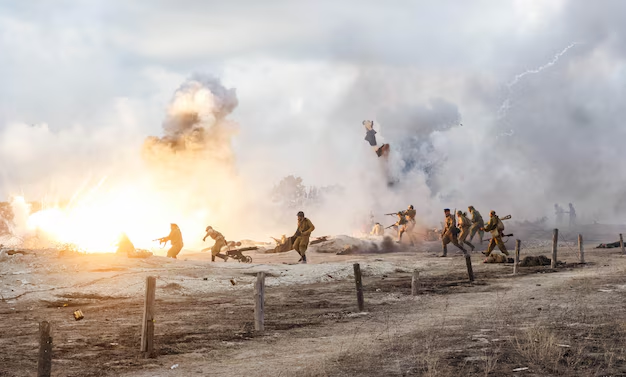
The battle turned into a bloody, all‑day fight with:
- Hand‑to‑hand combat in fields and wooded areas
- Multiple Confederate attacks against prepared Union positions
- Heavy casualties on both sides
While this wasn’t yet a dense urban center like modern downtown, the battle took place in what we’d recognize today as the eastern neighborhoods of Atlanta, not far from the heart of the city.
Outcome of the Battle
Despite the ferocity of the Confederate attacks, Union forces held their ground. The Confederates failed to push Sherman’s army away or break its lines.
From a military standpoint, this meant:
- The Union grip around Atlanta tightened
- Confederate forces suffered losses they could not easily replace
- Hood’s attempt to save the city by sudden attack did not succeed
The city itself was not captured that day, but the Battle of Atlanta made its eventual fall almost inevitable.
Why the Battle Led to Atlanta’s Fall
The Battle of Atlanta was part of a larger siege and encirclement. After July 22, fighting continued around the city through late summer.
Cutting the Railroads
Sherman’s strategy focused on choking off the city, especially by:
- Destroying key rail lines into and out of Atlanta
- Bombarding the city’s defenses and infrastructure
Once the railroads were cut, Confederate forces in Atlanta had:
- Limited supplies
- Reduced ability to bring in reinforcements
- Growing pressure to abandon the city
Atlanta was finally evacuated and occupied by Union forces in early September 1864.
Destruction and “The City That Burned”
After the city fell, much of Atlanta’s military and industrial infrastructure was deliberately destroyed to keep it from being used again by Confederate forces.
This destruction is one of the reasons Atlanta later came to be known as a city that rose from the ashes. If you’ve seen the phoenix symbol used by the City of Atlanta, it’s rooted in this history of destruction and rebirth.
How the Battle of Atlanta Still Shows Up in the City Today
If you’re in Atlanta and curious about this history, there are still many ways to see where and why the battle happened.
Key Sites Connected to the Battle
Here are a few locations where the story of the Battle of Atlanta is remembered or interpreted today:
| Site / Area | What It Relates To | Why It Matters Locally |
|---|---|---|
| Historic Oakland Cemetery (248 Oakland Ave SE) | Burials of soldiers, civilians, and notable Atlantans from the Civil War era | Gives a human face to the battle and its aftermath |
| East Atlanta & Edgewood neighborhoods | General area of heavy fighting on July 22, 1864 | Modern neighborhoods built over former battle lines |
| Atlanta History Center (130 West Paces Ferry Rd NW) | Exhibits on the Civil War and Atlanta’s role | Helps explain how the battle fit into the larger Atlanta Campaign |
| Cyclorama painting (housed at the Atlanta History Center) | Depicts the Battle of Atlanta | Offers a large‑scale visual interpretation of the battle |
While many original battlefield areas have been developed, street names, markers, and neighborhood histories still echo what happened here.
The Cyclorama and Public Memory
For years, the Atlanta Cyclorama—a huge panoramic painting of the battle—was displayed in Grant Park. It’s now at the Atlanta History Center, where it has been restored and presented with additional context.
Visiting it helps answer:
- How did people in Atlanta remember the battle over time?
- How did those memories change as the city grew and diversified?
This shows that the question “Why did the Battle of Atlanta happen?” isn’t just military; it’s also about how Atlanta tells its own story.
What Someone in Atlanta Today Can Take Away
If you live in or visit Atlanta, understanding why the Battle of Atlanta happened can help you see the city differently:
- Transportation matters: The same geography that made Atlanta a vital railroad hub in 1864 underlies today’s role as a center for interstates, airports, and freight rail.
- Rebuilding is part of the identity: The destruction and recovery after the battle contributed to Atlanta’s self‑image as a place of renewal and growth.
- Neighborhoods have deep roots: Areas like East Atlanta, Kirkwood, Edgewood, and Grant Park are not just trendy or historic—they sit on ground that shaped national history.
In essence, the Battle of Atlanta happened because this city was too important to ignore—militarily, economically, and symbolically. That importance is one of the reasons Atlanta remains such a central city in the South today.