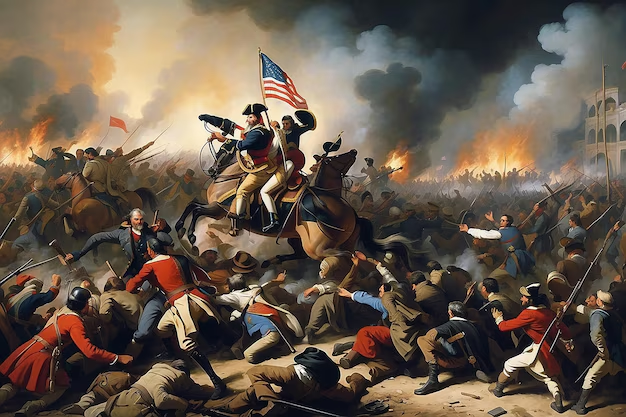
Who Won the Fall of Atlanta? A Local’s Guide to This Historic Turning Point
If you live in Atlanta or you’re visiting the city, you’ll see references to the “Fall of Atlanta” all over town—at museums, in neighborhood names, and even on historical markers near downtown and Midtown. When people ask, “Who won the Fall of Atlanta?” they’re usually asking about a very specific moment in the Civil War, and what it meant for the city and the country.
Here’s a clear, Atlanta-focused explanation of who “won”, what actually happened, and how you can still see the impact of the Fall of Atlanta in the city today.
The Short Answer: Who Won the Fall of Atlanta?
In military terms, the Union Army won the Fall of Atlanta during the American Civil War.
- The city of Atlanta was captured by Union General William Tecumseh Sherman on September 2, 1864.
- The Confederate forces withdrew from the city and destroyed supplies they couldn’t take with them.
- After the Union took control, Atlanta became a key base for Sherman’s later operations, including his famous “March to the Sea.”
So, if you’re answering a history question, the direct answer is:
But for Atlantans, the story is a lot deeper than just who “won.” It reshaped the city’s future, growth, and identity.
What Was the Fall of Atlanta?
When people talk about the “Fall of Atlanta,” they’re referring to the capture of Atlanta by Union forces in 1864 after several months of battles and a long campaign across North Georgia.
Atlanta was important because:
- It was a major railroad hub for the Confederacy.
- It handled transport of troops, weapons, and supplies.
- It was a key industrial and logistical center, not just a Southern city.
For someone living in Atlanta today, you can think of it this way: if the rail lines and logistics that run through the modern metro area suddenly went offline, it would affect huge parts of the country. In 1864, Atlanta played a similar role for the Confederacy.
Key Players in the Fall of Atlanta
Union Side (the “winners” of the Fall of Atlanta)
- General William Tecumseh Sherman – Led the Union campaign through North Georgia and the capture of Atlanta.
- Union Army of the Tennessee, Army of the Cumberland, and Army of the Ohio – These were the main Union forces involved in the campaign that ultimately led to the city’s fall.
Confederate Side
- General Joseph E. Johnston – Initially commanded Confederate forces defending Atlanta and North Georgia.
- General John Bell Hood – Replaced Johnston and led the Confederate defense during the final phase of the Atlanta Campaign, including several major battles around the city.
While the Union Army clearly “won” the military struggle for Atlanta, the city itself survived and eventually rebuilt, which is a big part of Atlanta’s identity today.
Why Did the Union Want Atlanta So Badly?
For a city resident or visitor, understanding the “why” behind the Fall of Atlanta helps make sense of the markers and museums you see around town.
The Union targeted Atlanta because it was:
- A railroad crossroads: Major lines converged here, making it the Confederacy’s transportation lifeline.
- An industrial center: Factories produced weapons, ammunition, and other war materials.
- A supply hub: Food, equipment, and reinforcements moved through Atlanta.
Once Atlanta fell, the Confederate war effort was seriously weakened. This is why historians often describe the Fall of Atlanta as a major turning point in the Civil War.
Timeline: From Siege to Surrender
Here’s a simplified way to think about the timeline, useful if you’re trying to orient events around what you see in modern Atlanta neighborhoods:
| Period | What Happened | Where It Connects to Today |
|---|---|---|
| Spring–Summer 1864 | Union advances from North Georgia toward ATL | Areas north of the city, like Dalton and Kennesaw |
| July 1864 | Major battles around Atlanta | Near modern East Atlanta, Decatur, and Edgewood |
| Late July–August 1864 | Union lays siege and cuts rail lines | Around present-day West End and southwest ATL |
| September 1–2, 1864 | Confederates withdraw, Union enters Atlanta | Centered on what is now Downtown and Old Fourth Ward |
| Fall 1864 | City used as Union military base | Core city and rail corridors |
These aren’t exact neighborhood boundaries, but when you walk or drive around places like Peachtree Street, Decatur Street, West End, and Inman Park, you’re in areas that were directly affected by the campaign.
Did Atlanta “Lose” the Fall of Atlanta?
On the battlefield, yes—Atlanta was captured and much of the city was damaged or destroyed, especially rail yards and industrial areas.
But if you’re thinking in terms of long-term impact on the city, the story becomes more complex:
- Atlanta was heavily damaged but not erased.
- After the war, the city promoted itself as the “City Too Busy to Hate” and a symbol of Southern rebuilding and progress.
- Today’s Atlanta—its role as a major transportation, business, and cultural hub—grew out of its rebirth after the Civil War.
So while the Union Army won the Fall of Atlanta, the modern city emerged from that loss and built a new identity, which you can still see in the way Atlanta talks about itself.
Where You Can Explore the Fall of Atlanta in the City Today
If you’re in Atlanta and want to see where this history played out, there are several key places to visit. These spots help answer not just “Who won?” but also “What did it change?”
1. Atlanta History Center (Buckhead)
Address: 130 West Paces Ferry Rd NW, Atlanta, GA 30305
Phone: (404) 814-4000
The Atlanta History Center has extensive exhibits on the Civil War and the Atlanta Campaign, including artifacts, maps, and interpretations that make the military and civilian sides of the story easier to understand.
You can:
- Learn how the Union victory at Atlanta influenced the rest of the war.
- See how local neighborhoods fit into the 1864 landscape.
- Get a clearer sense of how Atlanta rebuilt after its defeat.
2. Cyclorama: The Big Picture (inside the Atlanta History Center)
The Cyclorama is a huge panoramic painting depicting the Battle of Atlanta. While the Fall of Atlanta came later, the painting focuses on one of the key battles that led up to the city’s capture.
For an Atlanta resident, this is one of the most vivid ways to see:
- How the Union and Confederate forces clashed around the city.
- Why this battle mattered to the eventual Union victory in Atlanta.
3. Oakland Cemetery (Grant Park area)
Address: 248 Oakland Ave SE, Atlanta, GA 30312
Phone: (404) 688-2107
Oakland Cemetery is one of Atlanta’s oldest historic sites. You’ll find:
- Graves of soldiers from the Civil War era.
- Monuments and markers that reflect how people in Atlanta remembered the war and the city’s fall.
- A direct sense of how locals were affected, beyond the battlefield maps.
4. Civil War Markers Around the City
Throughout Atlanta, especially in older neighborhoods, you’ll see historic markers describing troop movements and battle lines, often placed by state or local agencies. Common areas include:
- East Atlanta and the Battle of Atlanta area
- Kennesaw Mountain National Battlefield Park (just outside the city, but part of the same campaign)
- Roadside markers noting fortifications and skirmishes near what are now busy streets and highways
These markers help connect the Union victory and Confederate retreat to the places you drive by every day.
How the Fall of Atlanta Shaped the Modern City
For an Atlantan trying to connect the past to today, it helps to look at what the Union “win” eventually led to:
- Railroads rebuilt and expanded – Atlanta remained a major transportation hub, eventually helping it become a center for commerce and logistics.
- New identity as a rebuilding city – After its defeat, Atlanta leaned into an image of progress and reconstruction, which later supported its role in business, politics, and civil rights.
- Urban layout shaped by wartime damage – Some parts of the city were rebuilt with new streets, rail lines, and industrial areas that still influence Atlanta’s layout.
In that sense, the Union victory didn’t just end Confederate control of Atlanta—it kicked off the long process that produced the modern metro area you see now.
Common Questions Atlantans Have About the Fall of Atlanta
Was the Fall of Atlanta the same as the burning of Atlanta?
They’re related, but not exactly the same event.
- The Fall of Atlanta refers to the Union capture of the city in early September 1864.
- The burning of Atlanta refers to the destruction of military and industrial sites, and some other buildings, mainly as the Confederates retreated and later as Union forces prepared to move on.
Many Atlantans associate the burning of the city with Sherman, but:
- Confederate troops also destroyed supplies and facilities to keep them from falling into Union hands.
- Union forces later destroyed additional rail infrastructure and military assets to prevent reuse.
Did the Fall of Atlanta decide the entire Civil War?
Historians often describe it as a major turning point, especially because:
- The Union victory at Atlanta provided political momentum in the 1864 presidential election.
- It weakened the Confederate war effort by cutting off a major hub.
However, the war continued for several more months, and other battles and campaigns were also critical.
Why does the Fall of Atlanta still matter to people who live here?
For Atlanta residents, the Fall of Atlanta is more than just a battle result:
- It explains why this city, rather than another, became a regional powerhouse.
- It’s part of the story behind Atlanta’s “phoenix rising from the ashes” symbol, visible on city seals and public art.
- It helps you understand why certain neighborhoods and transit routes look the way they do today.
Quick Reference: Who Won, and What It Means for Atlanta
Who won the Fall of Atlanta?
➤ The Union Army under General William T. Sherman.What did they win?
➤ Control of a major Confederate rail and supply center, weakening the Confederacy and boosting the Union war effort.What did Atlanta lose?
➤ Short-term: control of the city, major infrastructure, and significant property.
➤ Long-term: It lost its role as a Confederate stronghold but gained a new path as a rebuilt, modernizing city.Why should an Atlantan care today?
➤ The Fall of Atlanta explains much of the city’s layout, symbolism, growth, and ongoing identity as a place that rebuilt itself after near-destruction.
If you’re in Atlanta and curious about this history, exploring local sites like the Atlanta History Center, Cyclorama, and Oakland Cemetery will give you a firsthand sense of how a Union victory in 1864 continues to shape the city you live in or are visiting now.