
Atlanta’s Train System: How MARTA Rail and Other Trains Work in the City
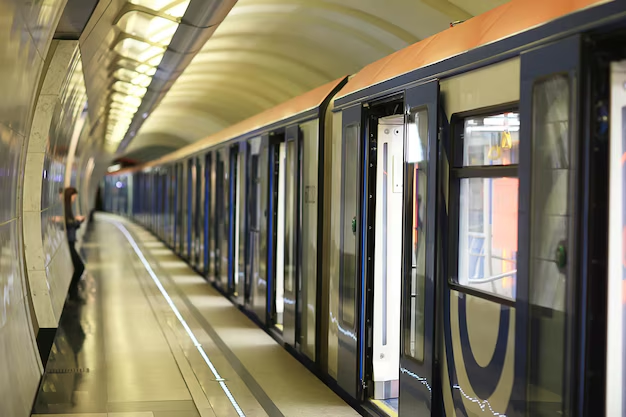
Atlanta does have a train system, but it may look different from what you find in cities like New York or Chicago. Instead of a large subway network, Atlanta’s main passenger train service is MARTA rail, supported by commuter rail-style connections at the airport, limited Amtrak service, and a growing streetcar line downtown.
If you live in Atlanta, are visiting, or are planning how to get around the city, here’s how the train system actually works on the ground.
The Core of Atlanta’s Train System: MARTA Rail
When people in Atlanta talk about “the train,” they almost always mean MARTA rail.
MARTA (Metropolitan Atlanta Rapid Transit Authority) runs the city’s main rapid transit system, with four main rail lines:
- Red Line – North–South (North Springs to the Airport)
- Gold Line – North–South (Doraville to the Airport)
- Blue Line – East–West (Indian Creek to Hamilton E. Holmes)
- Green Line – Short East–West branch on the west side (Bankhead to Edgewood/Candler Park)
Trains are mostly above ground, with a few underground segments in the core of the city.
Where MARTA Rail Goes
MARTA rail is designed around major job centers, neighborhoods, and the airport. It connects:
- Hartsfield–Jackson Atlanta International Airport
- Downtown Atlanta (Five Points, Peachtree Center, Georgia State)
- Midtown (Midtown, Arts Center)
- Buckhead (Buckhead, Lenox, Lindbergh Center)
- Westside (Ashby, West Lake, Hamilton E. Holmes, Bankhead)
- Eastside (Inman Park/Reynoldstown, Edgewood/Candler Park, Decatur, Indian Creek)
- Northern suburbs inside the MARTA service area (Sandy Springs, Dunwoody, North Springs, Doraville)
If you’re trying to reach major tourist spots like the Georgia Aquarium, World of Coca-Cola, or State Farm Arena, MARTA stations in Downtown and Midtown are usually your best starting point.
Quick Overview: Key Train Options in Atlanta
| Type of Train | Main Name/Operator | Typical Use Case |
|---|---|---|
| Rapid transit / Metro | MARTA Rail | Getting around Atlanta, especially city core + airport |
| Streetcar | Atlanta Streetcar | Short trips around Downtown / Sweet Auburn area |
| Intercity train | Amtrak (Crescent) | Long-distance travel to cities like New Orleans or NYC |
| Airport people mover | Plane Train + SkyTrain | Moving between airport terminals & nearby rental cars |
Using MARTA Rail: What Residents and Visitors Need to Know
How to Ride MARTA Rail
To ride MARTA trains, you’ll usually use a Breeze Card or Breeze Ticket, which you tap at the fare gates.
You can get these at vending machines in most stations, including:
- Airport Station (at the Domestic Terminal)
- Five Points (Downtown)
- Lindbergh Center
- Many other major stations
📝 Tip: Keep your Breeze Card handy; you’ll need it to enter and sometimes to exit certain stations.
When Trains Run
MARTA rail generally runs 7 days a week, from early morning until late at night, with:
- More frequent service at rush hour
- Less frequent service late at night and on weekends
If you are catching an early flight or staying out late, plan to check the current rail schedule before you go, since first and last train times can matter—especially to and from the Airport Station.
Getting to and from the Airport by Train
One of the biggest advantages of Atlanta’s train system is its direct connection to the airport.
- The Airport Station sits inside the Domestic Terminal, near baggage claim and Ground Transportation.
- Both the Red Line and Gold Line go to the airport, making it easy to reach from Downtown, Midtown, Buckhead, and points north.
This is often the fastest and most predictable way to get between the airport and central Atlanta during rush hour.
How Far Does MARTA Rail Reach?
Inside the City
Within the city of Atlanta, MARTA stations cover many high-traffic areas:
- Downtown: Five Points, Peachtree Center, Civic Center, Georgia State
- Midtown: North Avenue, Midtown, Arts Center
- Buckhead corridor: Lindbergh Center, Buckhead, Lenox
- Neighborhoods: Inman Park, West End, Candler Park, Edgewood, West Lake, Bankhead
From many of these stations, you can transfer to MARTA buses or walk, bike, or ride-share to nearby neighborhoods.
Outside the City Core
MARTA’s rail lines extend into parts of DeKalb County and Fulton County, including:
- North Springs, Sandy Springs, Dunwoody (Red Line north)
- Doraville (Gold Line north)
- Decatur and Avondale (Blue Line east)
If you live in suburbs beyond MARTA’s service area (like Marietta, Alpharetta, or Lawrenceville), you may:
- Drive to a park-and-ride MARTA station
- Use regional buses (such as CobbLinc or Gwinnett County Transit) to connect to MARTA
Atlanta Streetcar: A Short Downtown Train Line
In addition to MARTA rail, Atlanta also has the Atlanta Streetcar, a modern streetcar that runs on tracks embedded in the street.
Where the Atlanta Streetcar Runs
The streetcar forms a short loop around Downtown and the Sweet Auburn area, connecting places like:
- Peachtree Center
- Centennial Olympic Park / CNN Center area
- Edgewood Avenue
- Martin Luther King Jr. National Historical Park
It’s especially helpful for:
- Visitors staying in Downtown hotels who want to see nearby attractions
- Short hops between MARTA rail and nearby destinations
The streetcar currently serves a compact area, so think of it as a Downtown circulator rather than a full citywide rail line.
Long-Distance Trains: Amtrak in Atlanta
For intercity rail, Atlanta is served by Amtrak’s Crescent line, which connects the city to:
- New Orleans (to the southwest)
- Charlotte, Washington, D.C., Philadelphia, New York City, and beyond (to the northeast)
Amtrak Station in Atlanta
Amtrak operates out of:
Atlanta Peachtree Station
1688 Peachtree St NW
Atlanta, GA 30309
This small station is in the Brookwood area, roughly between Midtown and Buckhead. It is not connected by MARTA rail, but you can reach it by:
- Local bus (MARTA routes that serve Peachtree St NW)
- Taxi or rideshare
- Personal vehicle (limited parking nearby)
If you’re used to large, central train stations in other cities, know that Atlanta’s Amtrak station is more modest and less connected to the rest of the transit network.
Airport “Train” Systems: Plane Train and SkyTrain
Hartsfield–Jackson Atlanta International Airport has its own internal train systems that many people casually refer to as “the train.”
Plane Train (Inside Security)
The Plane Train is an automated underground train that:
- Connects all concourses (T, A, B, C, D, E, F) and the Domestic Terminal
- Runs inside the secure area after you pass through TSA
- Helps you move quickly between gates and terminals
If you have a tight connection, the Plane Train is often essential to getting to your next flight on time.
SkyTrain (Outside Security)
The ATL SkyTrain is an elevated people mover that:
- Connects the airport Domestic Terminal to the Rental Car Center
- Connects to nearby airport-area hotels and offices
You do not need a MARTA ticket or boarding pass to ride the SkyTrain; it’s part of the airport’s own system.
How Atlanta’s Train System Compares to a “Subway City”
If you’re coming from a city with an extensive subway system, Atlanta’s trains may feel:
- More limited in coverage, especially outside the core
- Less frequent late at night or on weekends
- More dependent on buses, rideshare, or driving for “last-mile” connections
However, for many common trips, the existing train network is very useful, particularly:
- Commuting between Downtown, Midtown, and Buckhead
- Traveling to Hartsfield–Jackson airport
- Getting to major event venues near MARTA stations (stadiums, arenas, and large parks)
Many residents use a hybrid approach:
- Rail for the long, congested portions of the trip
- Car, bike, scooter, or bus for the first or last mile
Practical Tips for Using Trains in Atlanta
Best Uses for MARTA Rail
You’ll usually get the most value from the train system if you use MARTA rail for:
- Airport trips (to and from most central neighborhoods)
- Daily commuting along major corridors (e.g., from Brookhaven, Decatur, or Sandy Springs into Downtown/Midtown)
- Event days, such as games at State Farm Arena or Mercedes-Benz Stadium, to avoid parking and traffic
Combining Train and Bus
Many areas in Atlanta are better served by buses, with MARTA rail acting as your main “trunk line.” Common patterns include:
- Riding rail to Five Points, Lindbergh, West End, or Decatur
- Transferring to a MARTA bus for the neighborhood portion of your trip
If you’re planning to live in Atlanta without a car, it’s helpful to:
- Choose housing near a MARTA rail station, or
- Be close to frequent bus routes that feed into the rail system
Key Takeaways: Does Atlanta Have a Train System?
- Yes, Atlanta has a train system, centered on MARTA rail, with four main lines connecting the airport, Downtown, Midtown, Buckhead, and several nearby suburbs.
- Atlanta Streetcar provides short-distance rail service within Downtown and Sweet Auburn.
- Amtrak offers limited long-distance train service via Peachtree Station on the Crescent line.
- Airport trains (Plane Train and SkyTrain) make it easy to move around the airport and to the Rental Car Center.
- While Atlanta’s system is not as extensive as some older transit cities, it can be a reliable, efficient option for key routes—especially airport trips and travel along the city’s main north–south and east–west corridors.
If you’re in Atlanta, the train system is absolutely worth understanding and using, particularly when traffic and parking are major concerns.