
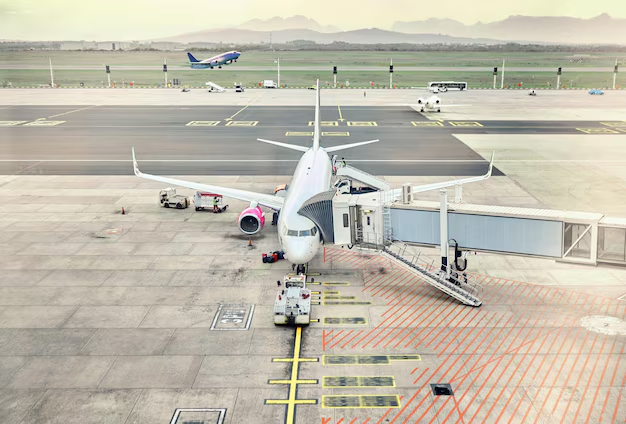
How Atlanta’s Hartsfield-Jackson Airport Is Powered by Science
Hartsfield-Jackson Atlanta International Airport (ATL) is best known as one of the world’s busiest airports. But if you live in Atlanta, are flying in for a visit, or just trying to understand how the airport works, it helps to know this: ATL runs on science.
From the way planes land in thunderstorms to how your checked bag finds the right flight, science is built into almost every part of getting here and getting around.
Big Picture: Where Science Shows Up at ATL
If you’re traveling through Atlanta, you’re interacting with science in at least five key ways:
- Aviation and flight science – how planes take off, land, and safely navigate the skies over Atlanta
- Weather and climate science – especially for thunderstorms, summer heat, and winter icing
- Transportation and logistics – how people and luggage move efficiently around such a large hub
- Engineering and construction – the runways, terminals, and underground train systems you use
- Environmental science – how the airport manages noise, air quality, and nearby communities
Understanding these areas can make your trip smoother and help you know why things like delays, runway changes, or security processes happen the way they do.
Flight Science: How Planes Operate In and Out of Atlanta
Aerodynamics and Takeoff/Landing
Every time a plane takes off from or lands at Hartsfield-Jackson, it is using basic aerodynamics:
- Lift: The curved shape of airplane wings creates lower pressure on top and higher pressure below, lifting the plane into the air.
- Thrust: Jet engines provide forward push so the wings can generate lift.
- Drag and weight: Pilots and onboard computers constantly balance drag (air resistance) and the plane’s weight.
For you as a traveler, this shows up when:
- Flights use different runways depending on wind direction. ATL’s parallel runways are oriented so planes can take off and land into the wind as much as possible.
- You feel rapid acceleration on takeoff and firm braking on landing to meet the runway’s length and safety margins.
Air Traffic Control and Navigation Over Atlanta
Flying into a dense metro area like Atlanta depends heavily on navigation science and systems engineering.
ATL works closely with:
- Atlanta Air Route Traffic Control Center (in Hampton, GA) – manages high-altitude traffic in and out of the region
- Hartsfield-Jackson tower – directs takeoffs, landings, and ground movements on the runways and taxiways
Using radar, GPS-based systems, and standardized flight routes, controllers manage:
- Arrival and departure paths that safely separate planes
- Holding patterns you may experience in the air during heavy traffic or storms
- Noise-abatement routes to reduce the impact on nearby neighborhoods
If your pilot announces, “We’re in a hold due to congestion,” that’s air traffic science at work to keep everyone safe.
Weather Science: Why Atlanta Storms Affect Your Flight
Thunderstorms and Summer Weather
Atlanta’s summer thunderstorms and humidity strongly affect operations at Hartsfield-Jackson.
Meteorologists at and around ATL monitor:
- Thunderstorm development: especially afternoon storms that can pop up quickly
- Lightning activity: ramp workers must clear the tarmac when lightning is too close
- Wind shear and microbursts: dangerous sudden changes in wind speed or direction
What this means for you:
- You may see ground holds or delayed boarding when lightning is in the area.
- Flights may reroute or circle to avoid storm cells.
- Departures may be staggered to maintain safe separation in turbulent air.
These aren’t random decisions – they follow conservative safety thresholds grounded in atmospheric science.
Winter Operations and Icing
Atlanta doesn’t see heavy winter weather as often as some northern cities, but when it does, the science behind de-icing and runway safety becomes critical.
At ATL, ground crews apply:
- De-icing fluids to remove ice and snow from wings and control surfaces
- Anti-icing treatments to prevent ice from reforming before takeoff
Runway friction is monitored, and planes may:
- Use longer takeoff distances
- Face weight restrictions or route changes
If you’re flying out on a cold, wet morning and see trucks spraying planes, that’s applied chemistry and physics protecting lift and control.
Getting Around the Airport: Transit, Flow, and Human Factors
The Plane Train and Airport Layout
Hartsfield-Jackson’s underground Plane Train is a direct example of transportation engineering and systems design.
It’s designed to:
- Move large numbers of passengers quickly between Terminals (Domestic & International) and Concourses T, A, B, C, D, E, and F
- Minimize walking distance for most travelers
- Reduce missed connections by shortening transfer times
From a science standpoint, the system is built on:
- Traffic flow modeling – estimating where and when crowds will form
- Energy and mechanical engineering – powering the train system safely underground
- Redundancy – multiple trains and control systems in case of breakdowns
If you live in metro Atlanta and pick up visitors often, knowing how this system works helps you plan:
- Tell arriving guests which concourse to expect
- Meet them at the Domestic Terminal (North or South) or International Terminal (Maynard H. Jackson Jr. International Terminal), depending on their airline and origin
Passenger Flow and Security Screening
Transportation science also shapes how the TSA security checkpoints and customs areas are laid out.
Designers use principles from:
- Queueing theory – how to move people through lines with minimal backups
- Human factors and ergonomics – signage, lane markings, and layouts that reduce confusion
- Behavioral science – where people naturally slow down or cluster
This is why you see:
- Separate lines for PreCheck, standard screening, and sometimes family or assistance lanes
- Clear pathways from ticketing to security to the Plane Train
- Open waiting areas designed to keep people from crowding chokepoints
Knowing this can help you:
- Arrive earlier during peak times (early morning and late afternoon weekdays, holiday periods)
- Choose a less congested checkpoint if an alternative is available in your terminal
Behind the Scenes: Baggage, Cargo, and Logistics Science
Your Checked Bag and the Baggage System
ATL handles an enormous volume of bags every day using a mechanized baggage handling system driven by:
- Barcode and tag scanning – each checked bag is tied to a specific flight and route
- Conveyor routing logic – bags are sent down specific belts to reach the correct gate or transfer area
- Automation and controls – computers monitor flow, detect jams, and reroute if needed
For you as a traveler:
- Printing clear bag tags at check-in, checking them for correct destination and connection airports, and keeping your claim receipts are simple ways to work with this system.
- Short connection times at a hub like Atlanta can strain the system; even so, the routing is built to handle tight transfers as efficiently as possible.
Air Cargo and Supply Chains
Hartsfield-Jackson is also a major cargo hub, supporting Atlanta’s:
- Medical and pharmaceutical shipments
- E-commerce deliveries
- Automotive and manufacturing supply chains
Cargo science and logistics include:
- Cold chain management – keeping sensitive products at precise temperatures
- Routing and scheduling – optimizing flight and truck connections
- Hazardous materials handling – following strict safety protocols
Residents benefit when time-sensitive goods arrive reliably through ATL, whether that’s overnight packages, fresh produce, or specialized parts needed for local businesses.
Engineering the Airport: Runways, Tunnels, and Terminals
Runway Design and Maintenance
Hartsfield-Jackson’s multiple runways are the product of civil engineering and materials science.
Key science-based choices:
- Runway length and thickness: designed to support large, heavy aircraft under varying temperatures and weather
- Pavement materials: selected to resist cracking in Atlanta’s hot summers and occasional freezes
- Lighting and instrument landing systems: support low-visibility operations, especially important during foggy or stormy days
You experience the outcome of this every time:
- A pilot credits a specific runway number during approach or departure
- Your flight lands safely in low clouds or after a rainstorm
Terminals and Underground Systems
ATL’s tunnels, baggage areas, Plane Train tracks, and utility corridors depend on:
- Structural engineering – supporting the weight of runways, planes, and terminals above
- Electrical and mechanical systems – powering lighting, air conditioning, and life safety equipment
- Redundancy planning – backup power and systems to reduce disruptions
When you see construction or expansion projects at the airport, those are guided by long-term engineering planning to support future traffic and larger aircraft.
Environmental and Community Science Around ATL
Noise Management and Flight Paths
For many Atlanta residents—especially in neighborhoods in College Park, Hapeville, East Point, Forest Park, and other areas near the airport—aircraft noise is a big part of daily life.
Noise management involves:
- Acoustic science – measuring decibel levels and understanding how sound travels
- Flight path design – routing planes to minimize impact where possible
- Building and insulation programs – in some cases, soundproofing eligible homes, schools, or community buildings
If you live near the airport and want to understand or report concerns, you can contact:
- Hartsfield-Jackson Atlanta International Airport – Noise Office
6000 N Terminal Pkwy, Atlanta, GA 30320
Main airport information: (800) 897-1910 (varies by department; ask for the Noise Office or Community Affairs)
Calling ahead or checking current contact channels can help you get the most accurate, up-to-date support.
Air Quality and Emissions
Operating such a large airport in the Atlanta metro area requires attention to air quality and emissions:
- Aircraft and ground vehicles emit exhaust that must be managed responsibly
- Fuel storage and fueling operations are engineered to reduce spills and vapors
- Energy use in terminals is often managed with efficiency measures and monitoring systems
Environmental staff and partner agencies apply environmental science and chemistry to:
- Track local air quality
- Plan improvements in fuels, equipment, and energy use
- Coordinate with regional efforts led by organizations like the Georgia Environmental Protection Division or local planning agencies
Education, Research, and Atlanta’s Science Ecosystem
Connections with Local Universities
Atlanta’s strong academic presence—especially Georgia Tech, Georgia State University, Emory University, and local technical colleges—helps support the science used at Hartsfield-Jackson.
In the broader Atlanta area, you’ll find:
- Engineering and aviation research that influences airport design and operations
- Internships and co-op programs where students work with airlines, airport agencies, or transportation firms
- Data analysis and modeling projects that study passenger flows, safety, or environmental impacts
If you’re a student or professional in Atlanta interested in aviation, transportation, or environmental science, ATL is a major real-world laboratory for these fields.
Public Agencies Involved in Airport Science
Several public-facing organizations play roles related to ATL and science-based decisions:
- City of Atlanta – Department of Aviation
Hartsfield-Jackson Atlanta International Airport
6000 N Terminal Pkwy, Suite 4350
Atlanta, GA 30320 - Federal Aviation Administration (FAA) – Atlanta Offices – oversee air traffic and safety standards for the region
- Metropolitan Atlanta Rapid Transit Authority (MARTA) – applies transportation planning and operations science to connect the airport to the city via rail and bus
If you’re trying to understand policy decisions, expansions, or transportation planning around the airport, these are key points of contact.
Practical Takeaways for Atlanta Travelers
Science at Hartsfield-Jackson isn’t just abstract—it shapes the practical choices you make when getting here and getting around:
- Plan extra time during stormy weather ☔ – thunderstorms and lightning around Atlanta trigger science-based safety rules that can slow boarding, baggage handling, and departures.
- Use the Plane Train efficiently – it’s engineered to be faster than walking between concourses; follow signs and listen for announcements.
- Expect route or gate changes – navigation and traffic management science may require last-minute adjustments for safety and efficiency.
- Understand noise and environmental measures – if you live nearby, noise and air quality programs are grounded in measurable data and environmental science.
- View ATL as part of Atlanta’s tech and research scene – from university partnerships to sophisticated logistics, the airport is deeply integrated into the city’s scientific and engineering community.
In short, whether you’re dropping someone off, catching a MARTA train to the airport, or flying halfway around the world, Hartsfield-Jackson Atlanta International Airport is a living example of science in action across nearly every part of your journey.