
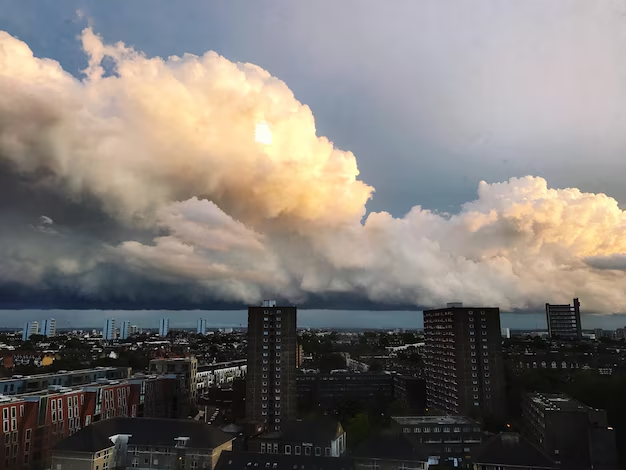
When Will It Rain Again in Atlanta? A Local’s Guide to What to Expect
If you live in the Atlanta, Georgia area, “When will it rain again in Atlanta?” is more than small talk. Rain affects commutes on the Downtown Connector, weekend plans on the BeltLine, and even water your yard gets during our hot summers.
Because weather changes constantly and forecasts update many times a day, no article can give a precise next-rain date and time that stays accurate. But you can understand:
- How Atlanta’s rain usually behaves by season
- Why rain can be so hit-or-miss by neighborhood
- How to check reliable, up-to-date forecasts
- What to expect during droughts, stormy stretches, or dry spells
This guide focuses on how Atlanta’s rain patterns work and how to find out when it’s most likely to rain again where you are.
Why You Won’t See a Single Exact “Next Rain” Answer Here
Weather in Atlanta is influenced by Gulf moisture, Atlantic systems, local thunderstorms, and passing cold fronts. That means:
- Forecasts are best for the next 1–3 days
- Confidence usually drops a bit after about 5–7 days
- Summer storms may pop up in one part of the metro and miss others completely
Because forecasts change hour by hour, the most honest and useful approach is to explain how to interpret Atlanta forecasts yourself and what patterns to expect throughout the year.
To know exactly when it will rain next in your part of Atlanta, you’ll need to check a current forecast or real-time radar (more on that below).
How Atlanta’s Rain Typically Works by Season
While any specific day’s rain is uncertain, Atlanta’s climate follows clear patterns. Knowing these helps you guess whether rain is more or less likely in the near future.
Winter (December–February): Cold Rains and Gray Days
In winter, Atlanta tends to get:
- Frequent light to moderate rain, often from large storm systems
- Cool, damp days with overcast skies
- Occasional freezing rain or a brief wintry mix, especially north of I-285
If it’s winter and a cold front or large storm system is moving through the Southeast, there’s a good chance of rain in Atlanta within the next few days.
What this means for “when will it rain again?” in winter:
- Dry spells of 7–10 days can happen, but long completely dry stretches are less common.
- Watch for mentions of “fronts,” “low-pressure systems,” or “widespread rain” in the forecast. Those usually signal good rain chances.
Spring (March–May): Unstable Weather and Thunderstorms
Spring in Atlanta is known for:
- Changeable weather — warm days followed by chilly, rainy ones
- Thunderstorms, sometimes strong, especially in late spring
- Fast-moving cold fronts that bring bands of rain
In spring, it might be dry for several days, then rain heavily for a day, then clear up again.
What this means for “when will it rain again?” in spring:
- Rain often returns with the next front, which can be every few days.
- Thunderstorms can form even on otherwise warm and sunny days, especially in April and May.
- Forecast phrases like “chance of afternoon storms” or “showers and thunderstorms likely” are common.
Summer (June–August): Hit-or-Miss Afternoon Storms
This is when Atlantans often feel like it could rain any afternoon — and they’re not wrong.
Typical summer pattern:
- Hot, humid days with temperatures often in the upper 80s or 90s
- Scattered pop-up thunderstorms in the late afternoon or early evening
- Storms that drench one part of the metro while another area stays mostly dry
What this means for “when will it rain again?” in summer:
- The city as a whole has some chance of rain most days, especially in the afternoon.
- Your specific neighborhood (Midtown, Buckhead, Decatur, College Park, etc.) might:
- Get a downpour at 4 p.m.
- Stay completely dry while storms pass a few miles away
- Forecasts often use phrases like:
- “Isolated storms” – fewer spots see rain
- “Scattered storms” – a decent number of areas get rain
- “Numerous storms” or “widespread storms” – many parts of the metro likely see rain
So the answer in summer is often:
Rain is likely somewhere in Atlanta in the next day or two, but it might miss your exact block.
Fall (September–November): Drier Spells with Periodic Rain
Fall is one of the most comfortable times in Atlanta, with:
- Lower humidity
- More clear, pleasant days
- Periodic rain from cold fronts or the remnants of tropical systems
Early fall (especially September) can still feel like summer, with some afternoon storms. Later in fall, rain tends to come in organized fronts rather than daily pop-ups.
What this means for “when will it rain again?” in fall:
- You may see longer dry stretches, especially in October.
- Rain tends to return around the next front, often described as:
- “Showers along and ahead of a cold front”
- “Rain chances increase late week as a front approaches”
If you’re in a dry spell in fall, look for mentions of an incoming front in your forecast to gauge when rain may return.
How Atlanta’s Neighborhoods Experience Rain Differently
In Atlanta, “Is it raining?” often depends on exactly where you are:
- A strong storm may be over Downtown while it’s dry in Sandy Springs
- Areas near Stone Mountain or higher terrain north of the city can sometimes see storms form or linger a bit differently
- Urban areas can experience a “heat island” effect, slightly influencing where storms form
This matters if you’re trying to plan activities like:
- Walking the Atlanta BeltLine
- Catching a game at Truist Park or Mercedes-Benz Stadium
- Spending the day at Piedmont Park or the Atlanta Botanical Garden
To get the best idea of when it will rain where you actually are, use a forecast or radar that allows you to zoom into your specific ZIP code or neighborhood.
How to Check When It Will Rain Again in Atlanta — Step by Step
Because conditions change quickly, the most practical way to answer “When will it rain again in Atlanta?” is to check updated, local tools. Here’s how.
1. Use the National Weather Service (NWS) Forecast for Atlanta
The National Weather Service (NWS) office that serves Atlanta is located in Peachtree City, Georgia. It provides:
- Detailed 7-day forecasts for Atlanta and surrounding counties
- Hourly forecasts that can show when rain is more likely during a given day
- Watches and warnings for severe storms, flooding, and more
You can:
- Search for “NWS Atlanta forecast” online.
- Enter your Atlanta ZIP code (for example, 30303 for Downtown, 30308 for Midtown, 30318 for West Midtown, 30316 for East Atlanta, etc.).
- Look at:
- Today/Tonight section for immediate rain chances
- Hourly Weather Forecast to see when rain is most likely
- 7-Day Forecast for the next week
The NWS Peachtree City office may also be listed as:
National Weather Service Forecast Office – Peachtree City, GA
4 Falcon Drive, Peachtree City, GA 30269
This office issues the official watches and warnings for the Atlanta metro area.
2. Check Local Atlanta TV and Radio Weather
Atlanta has several local TV stations with meteorologists who specialize in metro-area weather, including:
- Downtown, Midtown, Buckhead
- Suburbs like Marietta, Alpharetta, Decatur, College Park, and Stone Mountain
Local forecasts often highlight:
- Commute impacts on the Connector (I-75/85), I-285, I-20, and GA-400
- Storm timing (for example, “storms likely after 4 p.m.”)
- Specific neighborhood impacts, such as where heavier rain bands might set up
If rain timing matters for your day (kids’ sports, outdoor events, travel to Hartsfield–Jackson), local Atlanta broadcasts can give very practical, time-specific guidance.
3. Use Real-Time Radar for Your Exact Location
Radar is one of the best tools for seeing if rain is on the way in the next few hours.
To use radar effectively in Atlanta:
- Open any reputable weather app or website with live radar
- Zoom into:
- Your neighborhood (for example, West End, Old Fourth Ward, Virginia-Highland)
- Or your destination (for example, Truist Park in Cobb County)
- Watch how rain bands or storms are moving:
- If they’re approaching from the west or southwest, they may move over much of Atlanta.
- If storms are forming right over the city in summer, they can be brief but intense.
Radar helps answer questions like:
- Will this shower pass before I get to Piedmont Park?
- Is that dark cloud headed toward Hartsfield–Jackson Atlanta International Airport?
- Do I need to leave earlier to avoid heavy rain on I-75 or I-20?
Understanding “Chance of Rain” in an Atlanta Forecast
Forecasts often list a percentage, such as “40% chance of showers.” In the Atlanta area, this usually means:
- There is a 40% chance that measurable rain will fall at any given spot in the forecast area (not that it will rain for 40% of the day)
- The time window might be something like “noon to 8 p.m.” rather than an exact hour
Common phrases and what they usually imply:
- 20% chance (slight chance) – Most places stay dry, but a few spots may see a quick shower/storm.
- 30–50% chance (scattered chance) – Many areas could see rain, but it’s still possible your neighborhood stays dry.
- 60%+ (likely) – Rain is expected in a large portion of the area; timing and intensity may vary.
In summer, a 40–50% forecast often reflects pop-up afternoon storms. In winter, a 60%+ forecast might mean a broad area of steady rain moving through.
What If Atlanta Hasn’t Seen Rain in a While?
If you’re asking “When will it rain again?” during a long dry spell, especially in late summer or fall, you might be dealing with developing drought conditions.
Typical signs:
- Brown lawns and dry soil
- Lower levels in local creeks and streams
- Water-use reminders or restrictions from local authorities
In that case, watch the forecast for phrases like:
- “Pattern change” – often means a shift toward more frequent systems that can bring rain
- “Tropical moisture” – late summer and early fall can bring rain from Gulf or Atlantic systems
- “Fronts stalling over the area” – can lead to multi-day rain chances
To stay informed about water and drought conditions around Atlanta, you can look up:
- Georgia Environmental Protection Division (EPD) – provides information on statewide drought status
- Local county or city water departments, such as the City of Atlanta Department of Watershed Management, for water-use guidance
Rain and Everyday Life in Atlanta: Practical Tips
Because weather can change quickly here, a few habits can make life easier:
For Commuters
- ⏰ Check the forecast before rush hour. Rain can significantly slow traffic on I-285, GA-400, and surface streets.
- 🛣️ Be aware that heavy rain can cause ponding in low-lying spots and underpasses around the city.
For Visitors
- Pack a light rain jacket or small umbrella, especially in spring and summer.
- If you’re planning outdoor activities:
- Check the hourly forecast on the morning of your visit.
- Have a backup plan for indoor attractions like Georgia Aquarium or World of Coca-Cola.
For Outdoor Events and Sports
- Youth sports fields around metro counties (Fulton, DeKalb, Cobb, Gwinnett, Clayton) may close quickly after heavy rain.
- Check:
- County parks and recreation department websites or hotlines
- Event organizers’ updates for festivals or concerts (for example, in Grant Park, Piedmont Park, or Centennial Olympic Park)
Quick Reference: How Likely Is Rain in Atlanta Soon?
Use this simple table as a general guide based on season and forecast language. This does not replace a real-time forecast, but it can help you interpret what you’re seeing.
| Season | Typical Pattern | If Forecast Says… | Rough Expectation for Next Rain in Atlanta* |
|---|---|---|---|
| Winter | Cool, frequent systems | “Rain likely with next front” | Rain often within 1–3 days |
| Spring | Changeable, storms with fronts | “Showers and thunderstorms possible” | Rain possible any day fronts are nearby |
| Summer | Hot, humid, pop-up storms | “Scattered afternoon thunderstorms” | Many days have some risk, but hit-or-miss |
| Early Fall | Still warm, some storms | “Chance of showers/storms” | Similar to late spring/early summer |
| Late Fall | Drier, fronts bring most rain | “Showers along a cold front” | Rain with next front, dry in between |
*Always confirm with an updated local forecast for exact timing.
What You Can Do Right Now to Find Out When It Will Rain Again
To get the most accurate, up-to-the-minute answer for Atlanta:
- Check a current forecast from a trusted source (NWS, local Atlanta TV, or a reputable weather app) using your specific ZIP code.
- Look at the hourly forecast, not just the daily summary, to see when rain is most likely.
- Open a radar view and zoom into your neighborhood to see:
- If rain is already nearby
- How fast it’s moving toward or away from you
- If conditions look severe (strong storms, flooding concerns), pay attention to:
- National Weather Service alerts
- Local Atlanta news, radio, or official city and county announcements
By combining Atlanta’s seasonal patterns with live forecasts and radar, you can get a clear, practical sense of when it’s most likely to rain again where you are in the city.